
It is well established, that nearly every galaxy had multiple episodes of activity during its evolution. During this period matter is accreted by the central super massive black hole (SMBH) and an associated increase in brightness is observed. During such events outflows of hot matter, powered by accretion, sweep through the inner parts of the galaxy interacting with gas and dust on its way. Outflows cool, condense and lose momentum as they reach the outer regions. During this process interactions with denser molecular clouds (MC) take place. Molecular clouds are usually in delicate equilibrium with the surrounding medium and evolve relatively slowly but interactions with outflows change this equilibrium. These clouds are cradles for stars, responsible for the chemical evolution of the galaxy as a whole. Young massive stars evolve rapidly, dispersing newly created elements into the surrounding medium. It is typically assumed that AGN-driven outflows tend to be destructive and inhibit star formation. However, the result of the interaction can be very different depending on the properties of the outflow, such as gas temperature and momentum. Therefore, it is of particular interest to explore interaction of MCs with outflows of low momentum.
The analysis of such interaction is not new. While there are numerous models, a common approach is to reduce number of unknowns in the system. Such simplifications are useful as they help isolate certain evolutionary effects. But to make models more realistic, as much physical processes as possible must be included. It is very tempting to build a method that is suitable for a wide variety of systems and account for as many as physical processes as possible.
We use Arepo [1], a modern hydrodynamical code, which utilises a moving mesh to discretize the flow of matter. The code flexibility, combined with numerical accuracy and availability of different modules makes this tool a good candidate for this task. A model can be described as a virtual wind tunnel - an elongated volume with periodic boundary conditions on the sides and special boundaries at the ends. On the central axis, a turbulent molecular cloud of uniform density is placed with no initial velocity. The rest of the volume is filled with interstellar medium (ISM). We tested a range of ISM and cloud parameters: ISM temperatures $10^{4}$ – $10^{7}$ K and velocities 10 - 100 km s-1; cloud masses $10^{3}$ – $10^{5}$ M☉. Figure 1 illustrates one of the modelled systems. There is a tendency for faster flows to destroy clouds, while hotter flows compress them. The effect of cloud mass (coupled with density and radius) is to be determined.
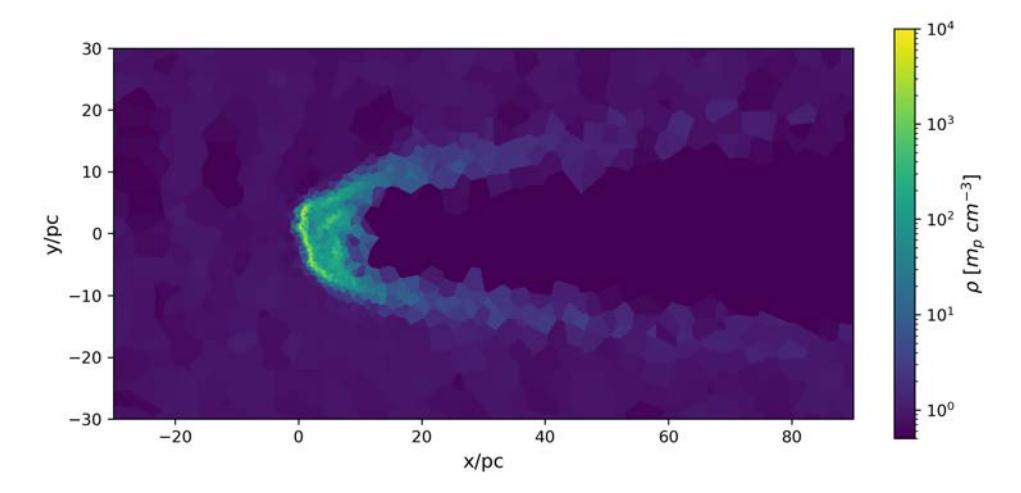
Modeled processes include gravity, cooling and heating, ionisation reactions, turbulence and, soon, star formation. The final goal is to map a parameter space where a boundary could be drawn separating destructive and nondestructive flows. A side product of simulations with the thermo-chemistry package is a possibility to trace chemical elements and ionisation states, which enables a more direct connection with observations.