
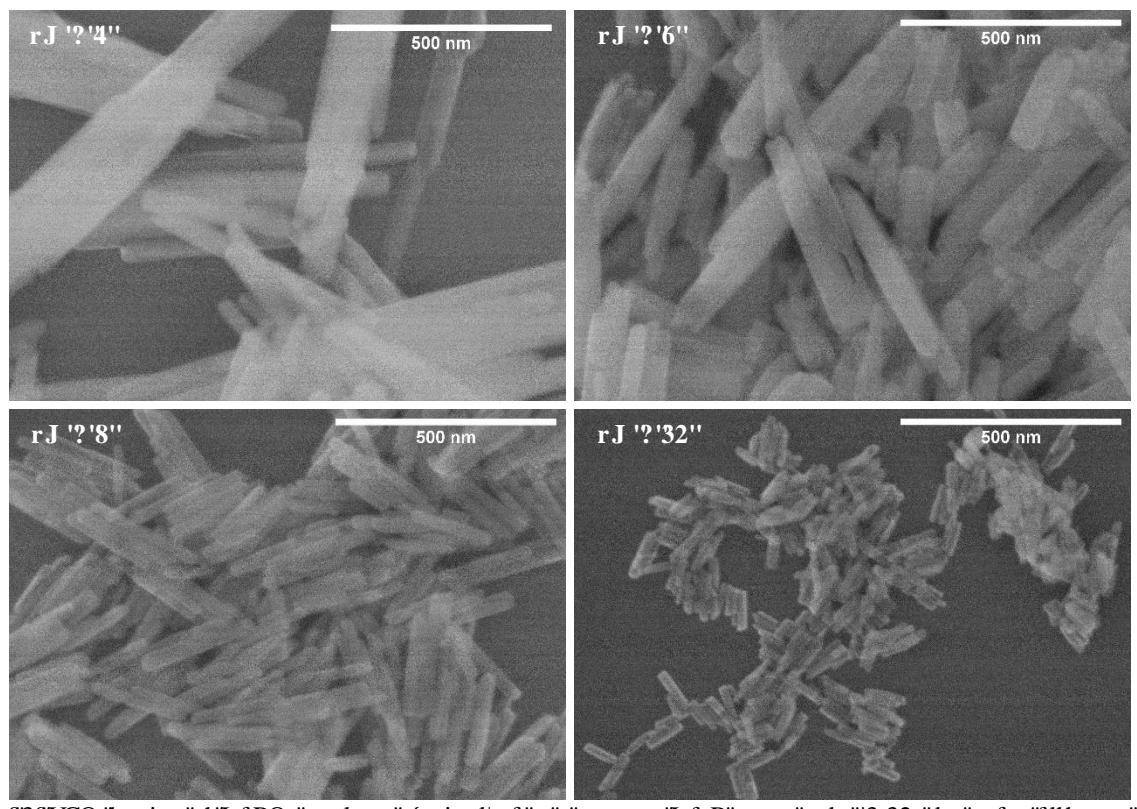
Hydrothermal reaction synthesis method was chosen to produce undoped GdPO4 samples in order to determine optimal synthesis conditions (Gd:P molar ratio and pH value of the reaction mixture) seeking to obtain nano-scale particles. As depicted in Fig. 1, GdPO4 nanorods (approx. 80 nm in length and 20 nm in width) are produced if the Gd:P molar ratio is equal to 1:10 and the pH value of the reaction mixture is equal to 10.
Further on our research focused on producing GdPO4 nanorods doped with Ce3+, Tb3+ and Eu3+ ions individually and in different two-ion combinations under fixed synthesis conditions (Gd:P = 1:10, pH = 10) following by the characterization of structural and optical properties of the obtained compounds.
Thus, detailed analysis and obtained results of XRD patterns, SEM images, reflection, excitation and emission spectra of GdPO4:Ce3+,Tb3+,Eu3+ and GdPO4:Ce3+/Tb3+,Eu3+ phosphors will be presented.