Galactic globular clusters (GGCs) were long thought to be simple stellar populations – stellar populations that have the same age and initial chemical composition. This view has changed with the discovery of multiple populations (MP) in the GGCs: first population (1P) with the chemical composition of Galactic field stars, and second population (2P) with anomalous chemical composition (enhanced He, N, Na and depleted O, C) [1]. It is therefore thought that the chemical composition of 2P stars has been modified during the cluster evolution. However, it is unclear how this could have happened because none of the mechanisms proposed so far is capable of explaining all observable properties of MPs in the GGCs [2].
Further and more stringent constraints on the possible evolutionary scenarios of the GCCs could be obtained by investigating abundance patterns of chemical elements that were produced by various processes of stellar nucleosynthesis, including those synthesised by neutron capture reactions. In this context, correlations between the elemental abundances may hint at their common origin and may help to identify the most likely evolutionary scenarios of the GGCs.
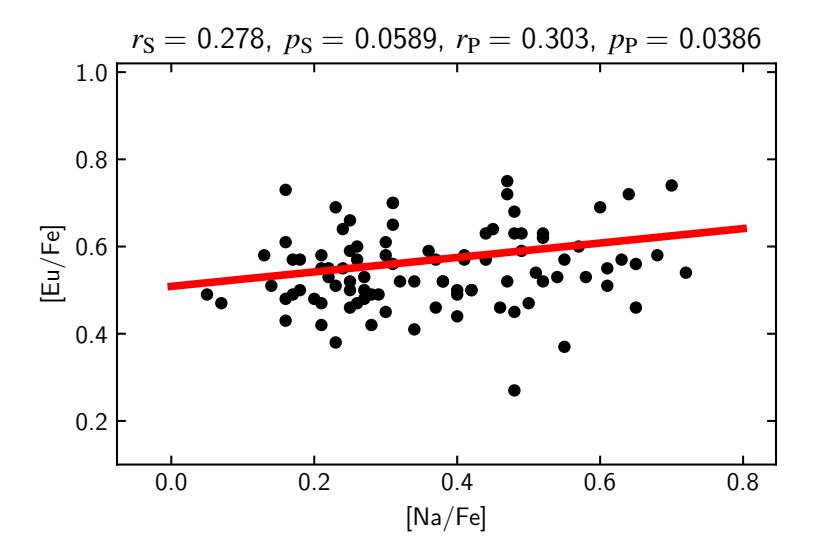
In this study we used ATLAS9 1D stellar atmosphere models and spectrum synthesis package SYNTHE [3] to determine europium abundance in the atmospheres of 93 red-giant branch (RGB) stars in Galactic globular cluster 47 Tucanae. Our results suggest the existence of weak but statistically significant [Eu/Fe]–[Na/Fe] correlation (Fig. 1). This is the first observational evidence that the 2P stars in the GGCs could have been enriched with the r-process elements. These r-process elements should have been synthesised by the same polluters that enriched the 2P stars with the light chemical elements. Because europium is produced only during explosive nucleosynthesis events (e.g. in Type II supernovae), this sets a new constraint on the candidate evolutionary scenarios of the GGCs, i.e. they should be capable of explaining the enrichment of both the light and r-process elements simultaneously.