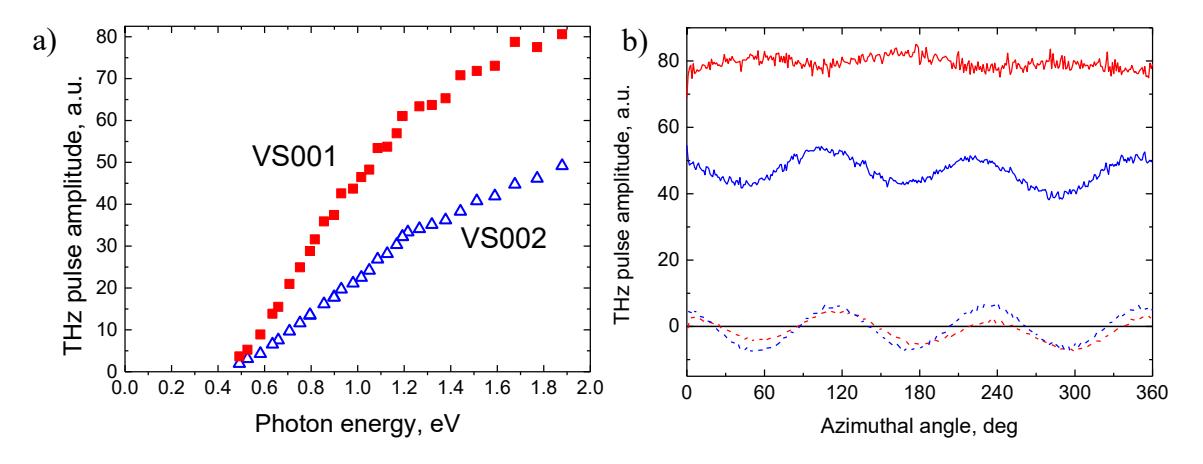
Terahertz (THz) frequency range measurement techniques have greatly improved over the last decades and are applied in many different application areas such as sensing, spectroscopy, imaging, and material characterization. THz emission spectroscopy (TES) is becoming popular technique for material characterization. THz pulses are generated on the material surface when it is photoexcited by femtosecond laser pulses. Laser pulses are inducing ultrafast changing photocurrents, which cause electrical dipoles radiating in the THz frequency range. THz pulse emission induced by femtosecond optical pulses has been observed in different semiconductors, gases and liquids. TES can be used to determine some parameters of the semiconductor band structure. These include direct band gap [1], subsidiary valley position [2] and conduction band offset position of heterojunctions [3].
In this work, we describe the effect of femtosecond optical pulse induced THz emission from thin bismuth layers. Thin bismuth (Bi) films are an interesting research object because of their rich variety of physical properties. Previously THz pulses were used for investigating bismuth only in two contributions [4,5]. In both works much thicker Bi samples were used.
Several Bi samples were grown on (111) oriented Si substrates using Molecular beam epitaxy system (MBE). The main difference in technological conditions between investigate samples was different substrate temperatures. It was equal to 100 °C for the layer VS001 and 20 °C for VS002.
The structure of the layers was studied by In-plane X-Ray diffraction (XRD) and their thickness by X-ray reflectivity (XRR). thickness of the both Bi films was approximately the same: $7.7 \pm 0.5$ and $8.8 \pm 0.5$ nm for VS001 and VS002 respectively. Measurements also showed that VS001 sample resembles polycrystalline film, while VS002 epitaxial layer is monocrystalline, with the hexagonal plane coinciding with sample's surface.
THz pulse emission from the Bi layers was investigated using femtosecond optical pulses from OPA Orpheus (Light Conversion). THZ emission spectra (fig 1 a) shows It can be seen that THz emission sets-on when the photon energy becomes larger than ~0.45 eV, which suggests that the energy band gap of these layers, and monotonously increases at higher photon energies. THz emission could be explained by photoexcited lateral currents in hexagonal crystals, such currents can be excited by optical beams polarized perpendicular to the main c axis. Both samples has an azimuthal angle dependence (fig 1 b), which is more pronounced in vs002 sample. This could be explained by shift current.