GaAsBi heterostructures are an attractive candidate to develop GaAs-based applications for long wavelength optoelectronics, such as infrared lasers, photodetectors, solar cells, terahertz devices [1], etc. This is mainly due to the large band gap reduction possible with incorporation of small amounts of Bi, relatively temperature insensitive band gap, high electron mobility, and large spin-orbit splitting. However, the exploitation of those GaAsBi heterostructures has been hampered by the practical difficulties of growing GaAsBi quantum wells with high emission at room temperature.
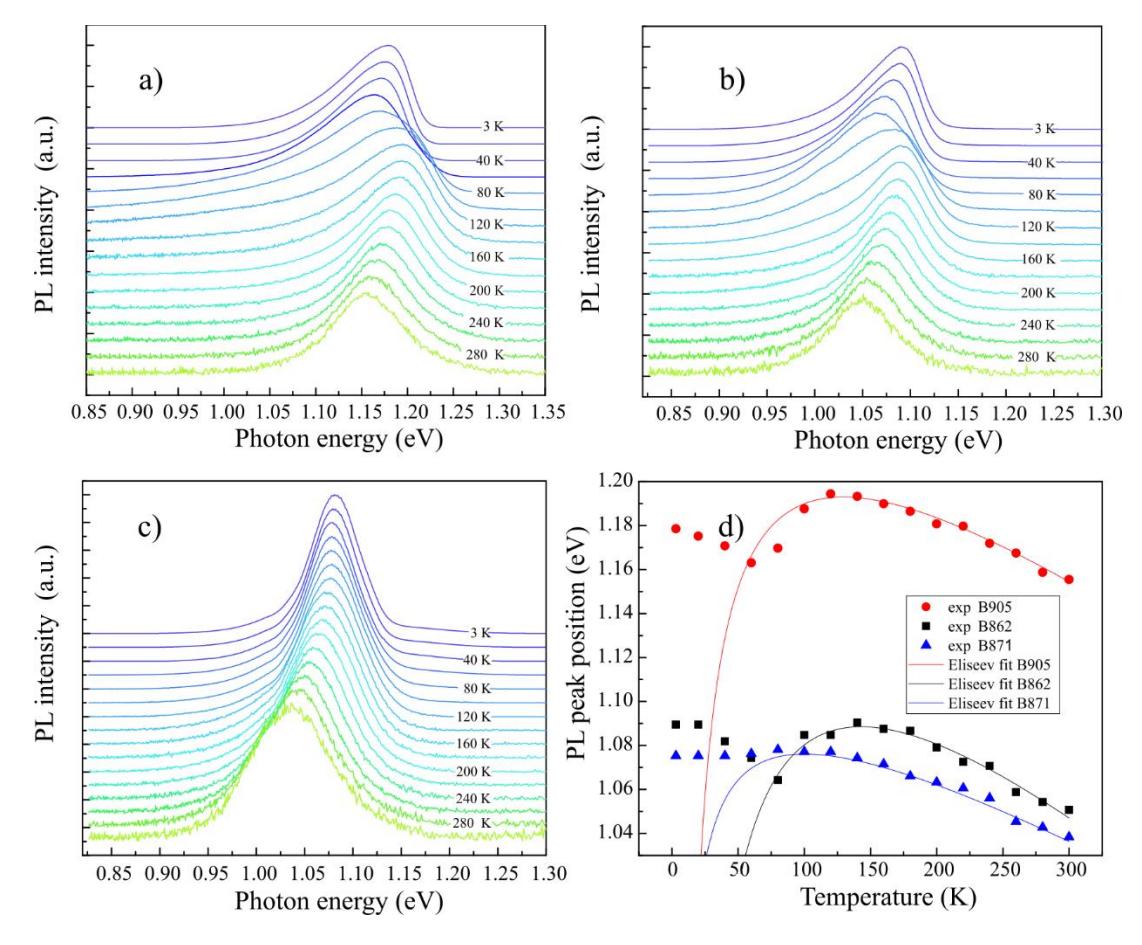
This work presents temperature- and excitation-dependent photoluminescence (PL) study of three GaAsBi/GaAs multi-quantum wells (MQW) structures grown by molecular beam epitaxy. All three MQW structures exhibits exceptionally high room temperature emission. Temperature-dependent PL measurements were used to explore optical interband transitions at temperature from 3 K to 300 K (see Fig. 1 a-c). PL peak position versus temperature (Fig. 1 d) were analysed using Varshni equation [2] or combined Varshni–Eliseev equations [3]. A broad PL emission band at room temperature together with S-shape character of PL peak position variation with temperature indicated effect of carrier localisation. As further matter, activation energies derived from PL measurements provided in-sight into thermal quenching processes of luminescence. Moreover, room temperature time-resolved photoluminescence spectroscopy (TRPL) was applied for study of carrier recombination in GaAsBi MQWs.