Application of renewable power sources carries new challenges concerning energy storage. Wind and solar plants are susceptible to atmospheric conditions. For example – wind farms produce energy only when sufficiently strong wind blows. One of the remedies to stabilize their output is utilization of battery storage stations. In this field, sodium-ion batteries are expected to be sustainable and cheap alternative to lithium ones [1].
Alluaudites, which structure was first described by Fisher in 1955 [2], are among potential cathode materials. NaxMnFe2(PO4)3 attracted much interest of Trad and co-workers, since its theoretical gravimetric capacity could be close to 170 mAh/g if reversibly cycled between x = 0 and 3 [3]. Poor electrical conductivity ($$\sigma(275^{\circ}\text{C}) = 9.7 \cdot 10^{-7} \text{ S/cm}$$ [4]) is one of the main obstacles to their implementation.
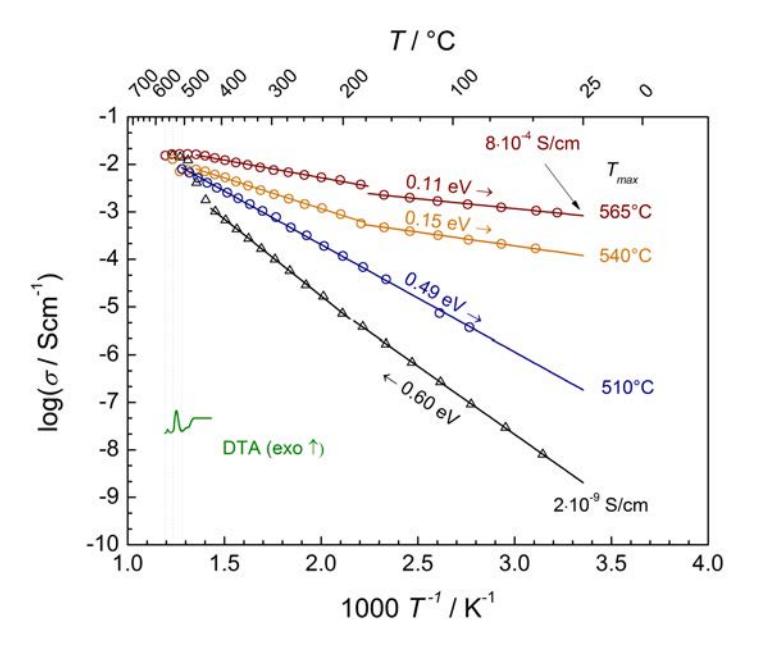
Alluaudite structure can be adopted by various compounds. In our research, we were studying materials with nominal composition of Na2Fe3(PO4)3, Na2Fe2V(PO4)3 and Na2FeMnV(PO4)3. Some of these compositions have been synthesized for the first time, as no such reports in the literature have been found. Thermal treatment of glassy samples led to nanocrystallization of alluaudite phase [5]. Previous studies on amorphous analogs of cathode materials for Li-ion batteries show significant increase of electrical conductivity as a result of their thermal nanocrystallization, due to occurring of preferable conditions for polaron hopping mechanism of conduction [6]. We have shown that similar procedure can be successfully applied to sodium compounds as well. In preliminary measurements, we observed a significant (5 orders of magnitude) and irreversible increase of conductivity, which resulted in receiving nanomaterial with $$\sigma(25^{\circ}\text{C}) \approx 10^{-3}$$ S/cm (Fig. 1).
We observed some impurity phases in the samples, though. Therefore, in this work, we strived to elaborate optimal syntheses conditions to obtain alluaudite-like nanomaterials with maximum possible phase purity. The following parameters were taken into account: reagents used, presynthesis of the reagents, cooling rate, role of reducing atmosphere.