Photosynthesis is undoubtedly one of the most important biochemical interactions in nature, which allows for the coexistence of countless life forms. Organisms, which carry out photosynthesis, have adapted to live in various ecological niches throughout the millions of years of evolution, which has resulted in roughly the same amount of net primary production executed on land and in water. Diatoms are a wide-spread species of algae, that performs approximately 20% of photosynthesis on Earth. Diatoms have a unique light-harvesting complex – fucoxanthin-chlorophyll protein (FCP), which has such chromophores as chlorophyll (Chl) c or fucoxanthin, that are not present in light-harvesting complexes in higher plants. These exceptional chromophores enable diatoms to survive in water, where penetrated light is mostly in the blue-green visible region. FCP complexes are not only responsible for light harvesting, but their chromophores also participate in the quenching of the photosystem in order to minimize the damage done by intensive light and therefore serves as an interesting research material due to systematic differences in their mechanisms from light harvesting complexes of higher plants.
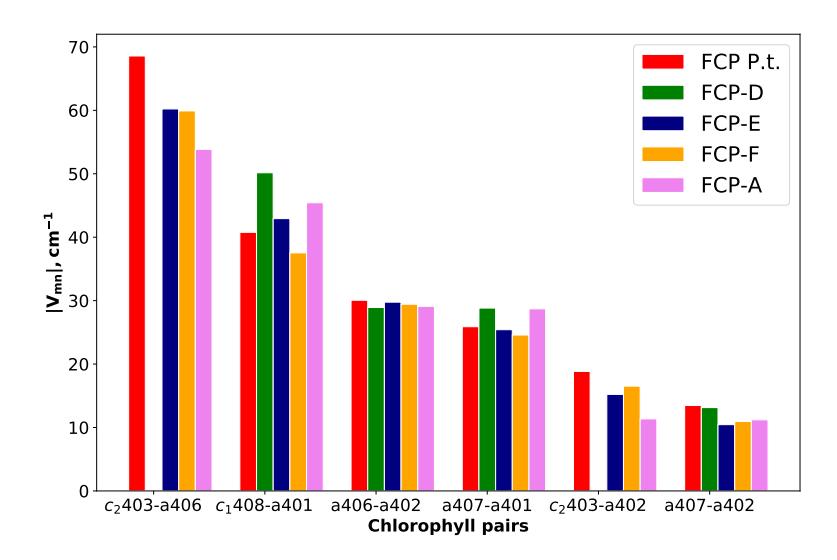
Only in 2019 two crystallographic structures of FCP were determined from Phaeodactylum triconutum [1] and Chaetoceros gracilis [2]. In this work interaction energy by point dipole approximation was calculated for various Chl a and c pairs in FCP monomers and FCP-A tetramer from the determined crystallographic structures. Transition dipole moment was formed in the direction from $N_{\beta}$ to $N_{D}$ atom (representing direction of the Chl $Q_{y}$ transition) and the center of the dipole was chosen the Mg atom in the center of porphyrin ring of chlorophylls. Results of the study indicate that for chromophore pairs present in all monomers interaction energy is really similar (Fig. 1), however, differences occur, when additional pigments are present in some of the monomers. These additional pigments interact strongly with some chlorophylls in the system. Strong interactions between chlorophyll c and chlorophyll a align well with the results from spectroscopic data [3]: there is a fast energy transfer channel (50 fs) from Chl c to Chl a. Notwithstanding, that does not have an impact on $Q_{y}$ peak position in absorption spectra and differences in absorption strength can be explained by the amount of pigments present in the monomer. Currently the chromophores of FCP are being modelled using Density Functional Theory and it is hoped that these calculations will provide some new insights about the system in the near future.