
Black carbon (BC) is the most strongly light absorbing component of particulate matter (PM) with short atmospheric lifetime (on the order of a few days to weeks) and thus BC not only has impacts on climate change but also has the potential to affect human health. The main sources of BC in urban environments come from incomplete combustion of fossil fuels and biomass burning. Due to its small size (less than 2.5 μm), BC can be inhaled deep into the lungs reaching alveoli and penetrate bloodstream causing cardiovascular, respiratory and other diseases [1, 2]. In the modern world, people spend 90% of their time indoors (home, offices etc.) where energy-efficient buildings can create risks for indoor air quality and health [3]. This study aims to investigate influence of outdoor-to-indoor exchange to indoor levels of BC. Continuous real-time measurements of optical absorption by aerosol particles were investigated in the urban region of Vilnius during the cold period (from October to December 2020). Equivalent black carbon (eBC) mass concentration was measured by an Aethalometer (Magee Scientific, model AE-31). The optical transmission of carbonaceous aerosol particles was measured sequentially at 7 wavelengths (λ= 370, 470, 520, 590, 660, 880 and 950 nm), where the eBC mass concentration was derived from the light absorption coefficient (ab) at a 880 nm wavelength.
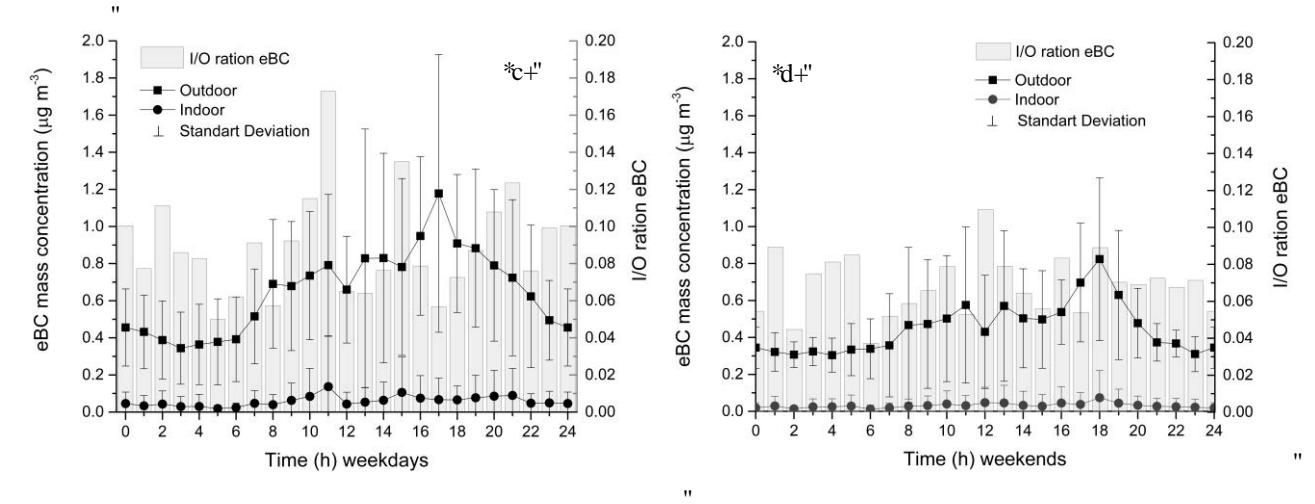
The results (figure 1 (a, b)) show a moderate influence of outdoor eBC emissions on the indoor eBC level. The weekend levels of eBC mass concentration were lower than in weekdays. Hourly mean mass concentrations of eBC for weekdays and weekends shows daily cycles, this can be explained by periodicity of traffic intensity and heating activities. The highest outdoor eBC mass concentrations (1.2 μg m-3) were observed between 16:00 and 18:00. Mean indoor/outdoor (I/O) ratios of the eBC mass concentration for the entire measurement period (calculated on a sample-by-sample basis) were found to be 0.12 (standard deviation - 0.26).