
The determination of halogens is a challenging task in Laser-Induced Breakdown Spectroscopy because these species have low excitation efficiencies, with their most intense emission lines being in vacuum-UV. Different strategies have been developed to increase sensitivity of detection, either involving the use of a noble gas atmosphere or the detection of molecular emission from species that recombine in the plasma (i.e. halogen and an alkaline earth metal). A particular case would be the detection of fluorine via emission of CaF [1]. However, this requires the sample to contain the alkaline earth metal; in order to surpass this circumstance, a nebulization method was developed. This method introduces calcium on a F-containing sample by directing a Ca-containing solution aerosol towards the laser's incidence spot. [2].
The physical effects of the nebulization components (i.e. Ar carrier, ultrapure water matrix, Ca nitrite solution) were later studied in a sequential manner on a F-free model sample (Cu), observing a strong alteration of the plasma plume shape and emission when the aqueous Ca-solution was introduced [3]. These studies were done with spatio-temporal resolution along the vertical axis of the plasma.
In the present work, with the purpose of further characterize the effects on the plasma, a double-detection experimental set-up was implemented. This way, a high-resolution spectrometer with both diffraction gratings and a mirror is used for precise spatio-temporal measurements while the overall emission (spatial and temporally integrated) is collected via optical fiber into a broad-range (200-600 nm) non-gated spectrometer. This double system can be used to monitor overall changes on the plasma while a specific parameter is studied. A schematized view of the complete experimental set-up is shown in Figure 1.
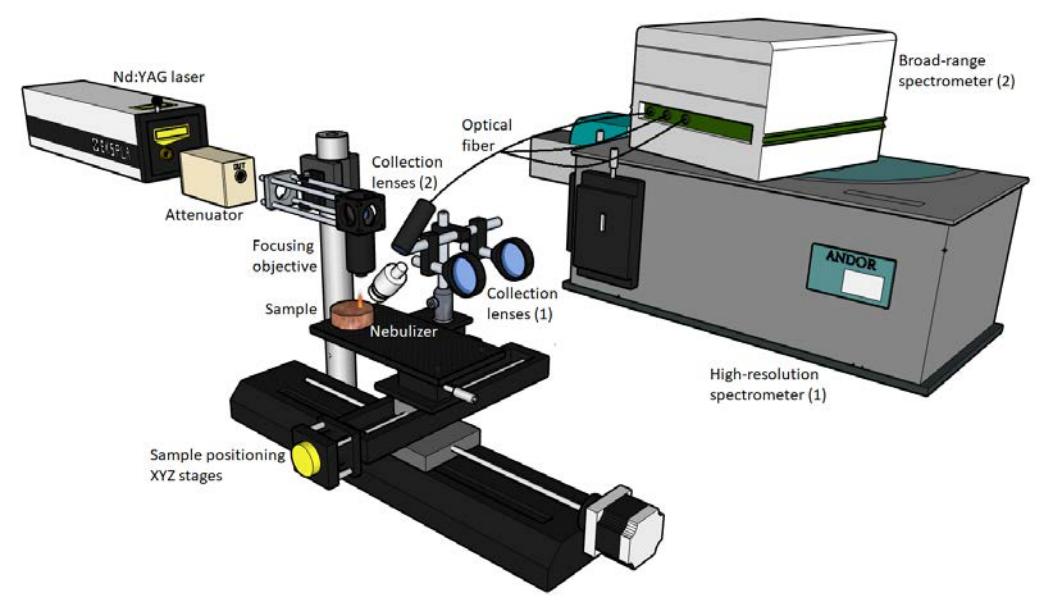
The studies carried out to characterize the nebulization effect on the plasma were performed for different Ca-solution concentrations (ranging from 0% to 15%) as well as without nebulization, as reference. As a first step, the double system was used to obtain excitation temperatures from both detection systems. One of them requires multiple spectra to cover all the wavelength exposures necessary to collect all emission lines, while the other allows for a full spectrum at each shot. Afterwards, electronic densities were obtained via Stark-widening of H-alpha emission line while monitoring the full emission. The results show a decrease on excitation temperatures that is dependent on the increasing amount of Ca and an alteration of the electronic density in the plasma, regarding both spatial distribution and numerical values.