
Quantum dots (QDs) exhibit extraordinary optical and physical properties, and, thus, have proven themselves in various fields of research including bio-imaging, biological labeling, drug delivery, photocatalyst, electrical devices and sensors [1].
One of the most promising types of QDs are boron nitride quantum dots (BNQDs), as they exhibit the unique physical and chemical properties [2], including excellent mechanical strength, high thermal stability, luminescent properties, large surface area, superb oxidation resistance, which provide extremely high drug-loading capacity, making them good candidates for various bio-medical applications. Therefore, significant attention has been paid recently towards the synthesis and fabrication of stable non-toxic BNQDs with controllable and scalable properties.
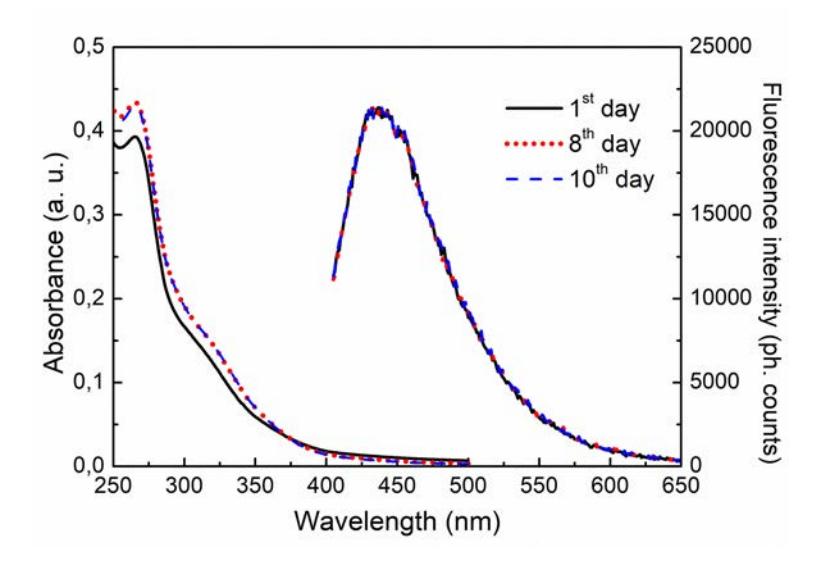
In this work BNQDs were synthesized via hydrothermal treatment of the mixture of boric acid and ammonia solution at 200°C for 12 h. Two-step purification was performed: (i) the large tracts were removed via filtration through 0,22 µm microporous membrane, (ii) solvent replacement for water was provided via evaporation at RT. The final solution was a stable transparent suspension without visible agglomerates. The spectroscopic properties of synthesized BNQDs solution were investigated by using steady-state and Raman spectroscopy. From UV-vis spectrum, the maximum absorption wavelength of BNQDs was found to be 265 nm as shown in Fig. 1. The wide emission peak is located at 430 nm under 375-nm excitation. Fluorescence quantum yield of BNQDs was calculated using Stilbene 420 as a reference and is about 6%.
Due to specific hexagonal BN atomic structure, anticancer drugs of the quinone-like structure are among the most suitable therapeutic agents that could be effectively delivered inside the cancer cell with BNQD 'shuttle'. Thus, synthesized BNQDs will be used further for optically guided delivery of quinone drugs and their subsequent controllable release inside the cancer cells.