
Biofuel ash (BA) and lime kiln dust (LKD) are industrial waste. BA is a complex and heterogeneous mixture of inorganic crystalline and amorphous minerals with organic matter [1]. BA usually contains mainly K, P, Ca and Mg, which are essential macroelements for plant growth [2]. Ash processing (granulation) uses similar methods, which are also used to produce mineral fertilizers. Granulation is the transformation of fine powdered materials into granular ones in interaction with the liquid phase. Granular materials are those with a particle diameter >0.5 mm. The granules of fertilizer products must be mechanically strong so that they can be easily transported and spread in the fields but at the same time capable of easily decomposing in the soil. Various synthetic or natural materials can be used as binders in the granulation process, including LKD [3]. At humidity, BA reacts with LKD to form compounds with binding properties.
In this study, biofuel ash granules were produced: BAG30, BAG50 and BAG70 containing 30, 50 and 70% ash. The other part consisted of lime kiln dust, 70, 50 and 30%, respectively. LKD and BP were weighed and mixed thoroughly using a homemade ribbon blade agitator. While agitating the mixture, a small amount of water (~ 12%) was added to the dry materials until small aggregates started to form a paste. The paste was granulated using a disc pelletizer. After granulation, the granules were dried at room temperature in a laboratory fume hood for 24 hours [4].
The samples were ground, sieved, extracted with aqua regia according to LST EN ISO 13650:2006. Atomic Absorption Spectroscopy (AAS) was used to find the concentration of Ca and Mg, flame photometer (FP) of K, UV-VIS spectrophotometer of P and inductively coupled plasma mass spectrometry (ICP-MS) of heavy metals [4]. The X-ray diffraction (XRD) data were collected with a DRON-6 powder X-ray diffractometer with Bragg-Brentano geometry using Ni-filtered CuKα radiation [5]. The particle size distribution was determined using the digital electromagnetic sieve shaker Filtra Vibracion FTL-0200 and the strength of the granules was determined using strength granule measurer IPG-1M in the measuring range between 5 to 200 N [4].
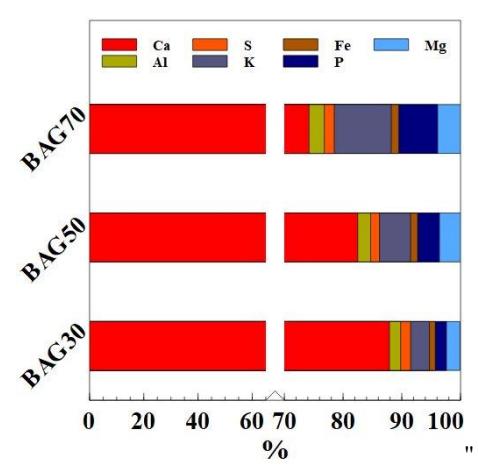
The analysis of chemical and physicochemical quality indicators of ash granules revealed that these substances consist mainly of chemical compounds containing Ca2+ ions (Fig.1).
The strength of the granules correlates with the amount of ash added to the mixture, i. e. the strength increases with increasing ash content in the granule, which weakens the release of nutrients from the granule. The strongest BAG were in the mixture with 70% ash. Higher-strength granules are easier to transport, less physically vulnerable, but have a negative aspect - they stay on the soil surface longer and do not release nutrients, so the most optimal BAG have the lowest ash content in the mixture, i. e. 30%.