Among all biosensors present on the market, glucose biosensors account for more than 85% [1]. In recent years, numerous studies have been conducted to improve biosensors measuring glucose in the blood using different nanostructures [2,3]. Gold nanostructures located on the surface of the electrode increase the conductivity, improve the electron transfer, and biosensor analytical characteristics such as sensitivity, selectivity and stability [4]. The proper immobilization of the enzyme on the electrode surface is one of the most important factors affecting the performance of the biosensors. Different methods could be used for enzyme immobilization on the electrode surface, namely, covalent attachment or cross-linking with bifunctional reagents, non-covalent adsorption, physical entrapment, and bio-conjugation [1].
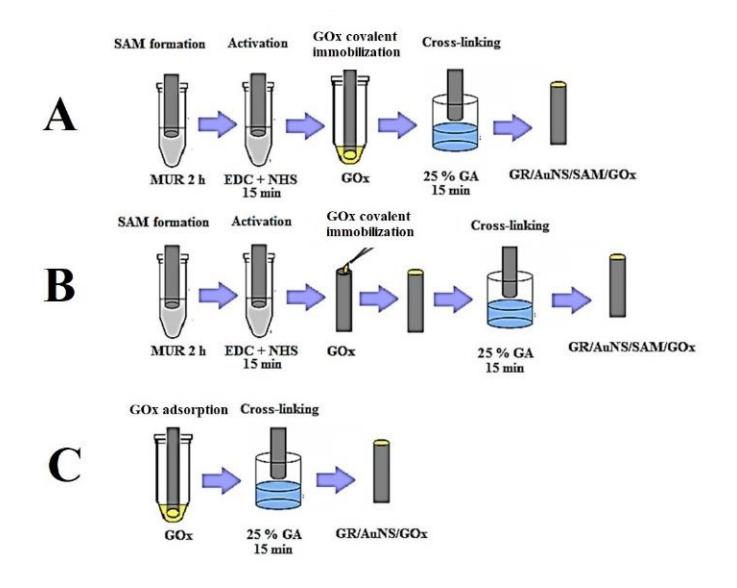
In this work, dendritic gold nanostructures (AuNS) were electrochemically formed on the surface of a graphite rod (GR) electrode. Different glucose oxidase (GOx) immobilization on the surface of GR/AuNS electrode methods were used: adsorption and covalent immobilization through a self-assembled monolayer (SAM) without and with cross-linking (Fig. 1). The impact of enzyme immobilization method on the performance of glucose biosensor was tested using potentiostat/galvanostat PGSTAT 30/Autolab (EcoChemie, Netherlands) with GPES 4.9 using three-electrode system. Glucose biosensor based on working electrode modified by GOx covalently immobilized on AuNS through 11-mercaptoundecanoic acid (GR/AuNS/SAM/GOx) and additionally cross-linked with glutaraldehyde (Fig. 1A) possesses higher sensitivity, repeatability, and better stability.