
Titanium dioxide (TiO2) coatings are multifunctional because they combine good chemical inertness, thermal stability, non-toxicity, as well as bactericidal and photocatalytic properties [1]. The plasma electrolytic oxidation method (PEO) allows direct growth of photoactive TiO2 layers with good mechanical adhesion and electrical contact with the substrate. The prospects of such layers are clearly demonstrated in the work [2]. Several authors recently reported that PEO TiO2 films outperform TiO2 nanotube arrays, exhibiting a quantum yield of over 90% when converting photons to electrons [3]. It is equally important to obtain such coatings not only on the titanium surface but also on more accessible materials, such as aluminum.
In this work, the PEO method for the deposition of TiO2 films on an aluminum substrate (99,9%) in an aqueous solution of 0,05 M (17,7 wt.%) potassium titanium oxide oxalate dihydrate (K2[TiO(C2O4)2]·2H2O) was used. Potassium titanium oxide oxalate dihydrate was used as a precursor for the formation of titanium dioxide during oxidation [4]. An aluminum anode and a titanium cathode were immersed in a water-cooled electrochemical cell and were connected to a direct current source. The synthesis time for the PEO coatings was 5 min. Two types of spark discharges have been identified: 280 V – a homogeneous minor yellow sparkling is observed on the surface (I oxidation mode); 330 V – the number of sparks decreases and at the same time they become much larger and acquire an orange-yellow color (II oxidation mode). The appearance (a), phase composition (b), and morphology (c) of the obtained PEO coatings are shown in Fig. 1.
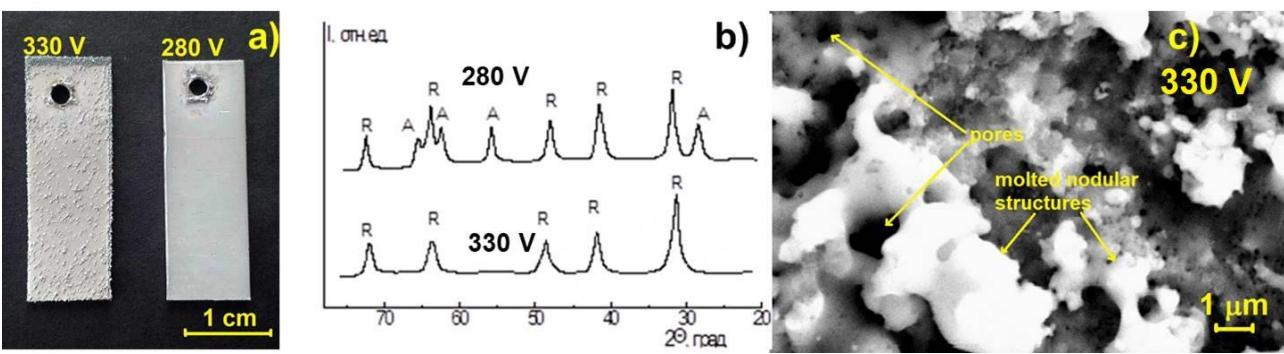
It was found that with an increase in the oxidation voltage from 280 V to 330 V (when the oxidation mode changes from I to II), the thickness of the coating increases (from 25 ± 3 μm to 40 ± 5 μm) and its roughness also increases (see Fig.1a). The color of both obtained coatings is white. XRD analysis (X-ray diffractometer HZG-4A) showed that the main phase in each sample of titanium dioxide is rutile, especially for the coating obtained at 330 V, and anatase is present in insignificant amounts for the coating obtained at 280 V (Fig.1b). A typical morphology of a PEO TiO2 coating is shown in Fig. 1c (the image was obtained using a scanning electron microscope (SEM) LEO-1455 VP). SEM shows the structure typical for PEO - coatings: the presence of pores and molted nodular structures. The higher the oxidation voltage (330 V) is, the larger the molted nodular structure sizes are and the worse the adhesion to the substrate is observed. To obtain denser coatings with good adhesion to the surface, it is preferable to carry out the synthesis at a lower sparking voltage mode (280 V).
It was found that the method of plasma electrolytic oxidation can be used to obtain titanium dioxide coatings on the aluminum surface. It is shown that, if the synthesis conditions are varied, it is possible to obtain oxide coatings with a different thickness and morphology. In the future, it is planned to obtain a series of TiO2 coatings for subsequent study of their composition and photocatalytic activity.