
The quantum efficiency of extensively used polar InGaN is deteriorated by the spatial separation of electrons and holes in the quantum well due to the built-in electric field. The field is absent in semi-polar and non-polar InGaN quantum wells, thus these types of InGaN receive an increasing attention. Two strongly overlapping bands are observed in the luminescence spectra of non-polar and semi-polar InGaN. Further research is needed to reveal the origin of these bands.
In this work, m-plane InGaN quantum wells have been studied using time-resolved cathodoluminescence (CL) spectroscopy. Attolight CL spectrometer Chronos has been exploited. The sample was excited with electron beam and the CL spectra were recorded with a CCD camera, whereas CL kinetics was registered with a streak camera.
In time-integrated CL mode, two InGaN-related strongly overlapping bands with peaks at 428 nm and 450 nm have been observed (see Fig. 1a). The band peaked at 362 nm is attributed to GaN which is expected from the capping layer. It was revealed that the increase in excitation intensity results in a faster increase in CL intensity for the band peaked at 428 nm than that for the band peaked at 450 nm. The spatial distribution of time-integrated CL intensity is inhomogeneous with high-intensity spots of ~200 nm in diameter. It was also observed that the spatial distribution of the peak wavelength showed that the band peaked at 428 nm dominates the CL throughout the entire sample surface at high excitation intensity. Meanwhile at low excitation intensity, competition among the two bands is observed from site to site.
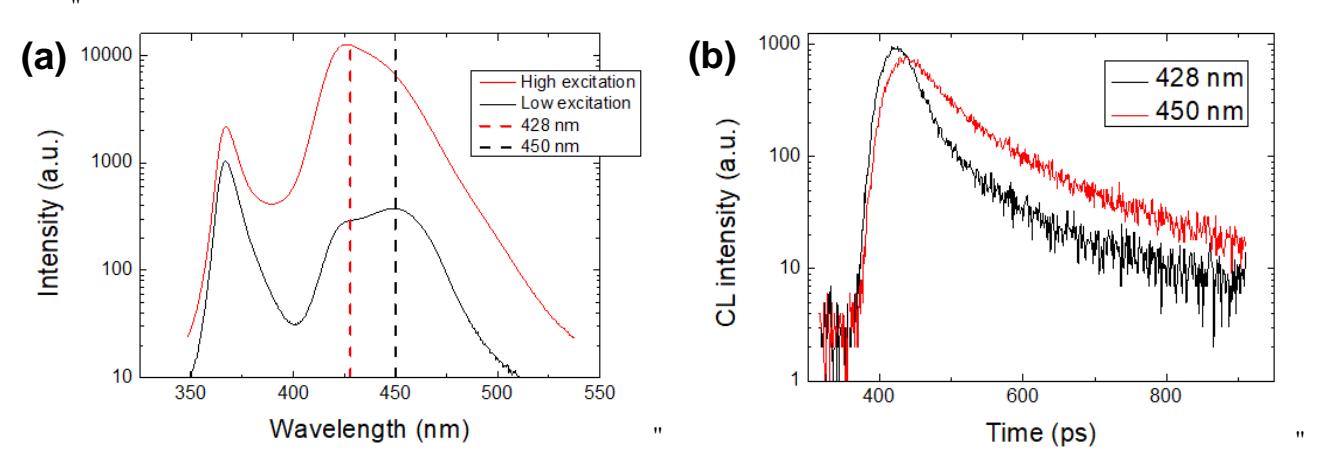
Using excitation in pulsed mode, the CL time evolution has been measured in different spots on the sample surface that have different CL intensity. In all the spots, the CL decay contains two components, fast and slow. CL intensity decay in one of the measured spots is shown in Fig. 1b. The decay time of the fast component of the band peaked at 428 nm is equal to 26 ± 2 ps, whereas it is almost twice as long (50 ± 6 ps) for the 450 nm band. The carrier lifetime of the slow component is the same for both bands within the limits of error. A strong positive correlation between the CL intensity and the decay time of the fast component is observed. The exact origin of double-peak emission is discussed.