
Selective etching is an important process in electronic and medicinal instrument manufacturing. However, it is a time-consuming process thus reducing manufacturing speed.
It is known that chemical etching rate (using potassium hydroxide KOH) of corona-charge treated domain of the soda-lime glass substrate is 1.6 times higher than that of normal glass [1]. Furthermore, it was observed that chemical etching rate (using potassium hydroxide KOH) of fs laser induced damage areas of soda-lime glass is up to 100 times higher [2].
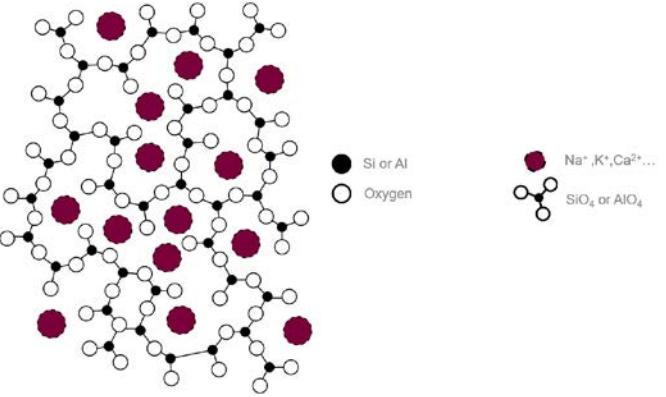
The purpose of this study is to analyse structural changes of soda-lime and more complex aluminosilicate ("Gorilla3") glasses when affected by fs laser pulses. Soda-lime glass is composed of silicon dioxide (SiO2), sodium carbonate (Na2CO3), calcium oxide (CaO) and aluminosilicate glass of additional aluminium oxide (Al2O3) and magnesium oxide (MgO) compounds. The structural network is formed by silicon and oxygen compounds in the shape of tetrahedrons, also known as Q species. Q species are connected by bridging oxygen atoms (Fig. 1). Alkali and alkaline earth elements work as network modifiers, consequently changing physical and chemical properties of the glass (Fig. 2). In this case aluminium in aluminosilicate glass works as glass former and aluminium tetrahedrons forming eing structures could be observed (Fig. 2).

In this study, soda-lime and aluminosilicate glasses samples were affected by a 1030 nm wavelength Bessel beam. Damaged samples were analysed with Raman spectroscopy. This method was chosen because Raman shift values of Q species compounds are precisely known and do not depend on alkali metal compounds in the glass structure [3]. In this research, Raman spectroscopy was done with a 532 nm wavelength excitation beam. By analysing the measured spectra, structural differences between damaged and normal glass can be determined. Analysis of the Raman spectra showed there was a noticeable difference in the quantity of Q species compounds in the damaged glass compared to normal glass.