
Nowadays there are plenty of old art works which require restoration or historical identification. Before restoring paintings or other art works it is important to know what materials were used while creating them [1]. Knowing what type of materials (including binders, extenders, fillers etc.) were used is also crucial in authentication of the artwork and the determination of painting's authorship, place and time of creation. Many methods have been employed to identify the chemical composition of the materials used in works of art but Raman spectroscopy is one of the fastest and most highly specific, and therefore suitable for this type of analysis. There is also a possibility to use Raman spectroscopy in situ which would help identify pigments and other paint components in an even faster and more efficient way. The main purpose of this work was to estimate the suitability of Raman scattering spectroscopy method for identification of commonly used red pigments in artworks and create a library of said pigments which could be used while analyzing real paintings and frescoes.
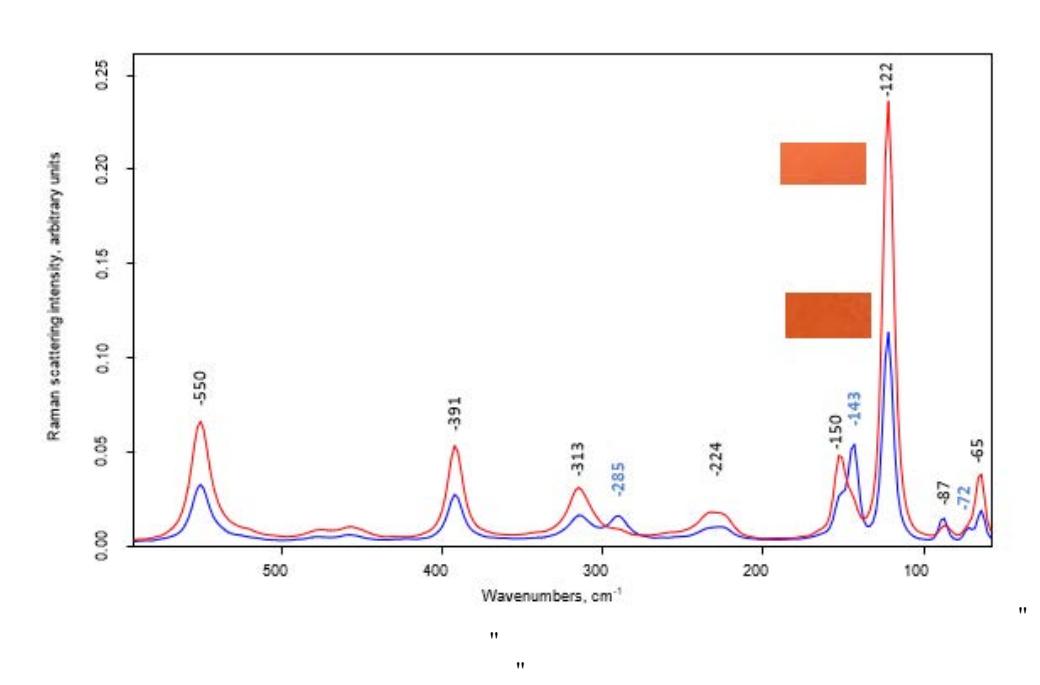
Different standard red pigment samples from Vilnius Pranas Gudynas restoration center were measured. During the study of these pigments, near infrared laser (1064 nm) was employed in order to reduce the risk of fluorescence. The one complication that often arose while measuring different samples was the need to adjust laser power and scanning time in order to obtain spectra with best signal to noise ratio and avoid sample heating and damage. Raman spectroscopy was used to identify specific bands of over ten red pigments. In addition, the spectra proved useful while following degradation of a pigment. In figure 1, two spectra of the same pigment (red lead) from different sources (Kremer standard pigment and Soviet pigment) are presented. It is possible to observe that the latter pigment has degraded from Pb3O4 to PbO from the relative intensities of the spectral bands in the 320-280 cm-1 and 160-130 cm-1 regions [2].
Some samples of original and restored frescoes from Vilnius University Littera bookstore were measured as well. The red pigment used in one of the frescoes and materials used in different plaster layers under the frescoes were identified as hematite, calcium carbonate and silicon dioxide.