
Drinking arsenic-polluted water causes serious health problems including irregular heartbeat, atherosclerosis and skin cancer [1]. Arsenic in natural waters usually exists in arsenite (As(III)) and arsenate (As(V)) as inorganic forms. It can also exist as organic dimethylarsinic and monomethylarsonic acids. Still, arsenite is more toxic than arsenate, the same as inorganic arsenic being more toxic than the organic arsenic forms [2]. Arsenic presence in aqueous media can be detected by several analytical methods such as atomic absorptions spectroscopy, inductively coupled plasma – atomic emission spectrometry, inductively coupled plasma – mass spectrometry, etc. [3]. These analysis are typically long and require expensive equipment; thus, electrochemical methods could be a good replacement as cheap, fast and easy methods for arsenic detection.
Herein, three different cobalt gold (CoAu) electrodes were prepared by electroless deposition of Co on Cu surface, followed by Au nanoparticles deposition on the prepared surfaces by galvanic displacement using three different deposition times (30, 60 and 300 s). Au loading was determined by energy-dispersive X-ray spectroscopy analysis and it was found to be 5.8, 7.1 and 15.3 μg cm-2 for CoAu(30s), CoAu(60s) and CoAu(300s), respectively.
Next, these electrodes were tested in 1 mM NaAsO2 in NaHCO3 + Na2CO3 buffer by anodic stripping voltammetry (ASV). Arsenic determination by ASV method proceeds in two steps where As(III) is reduced to As(0) as the adsorbed form on the electrode surface and then oxidized to As(III) form that diffuses into the solution, scheme 1.
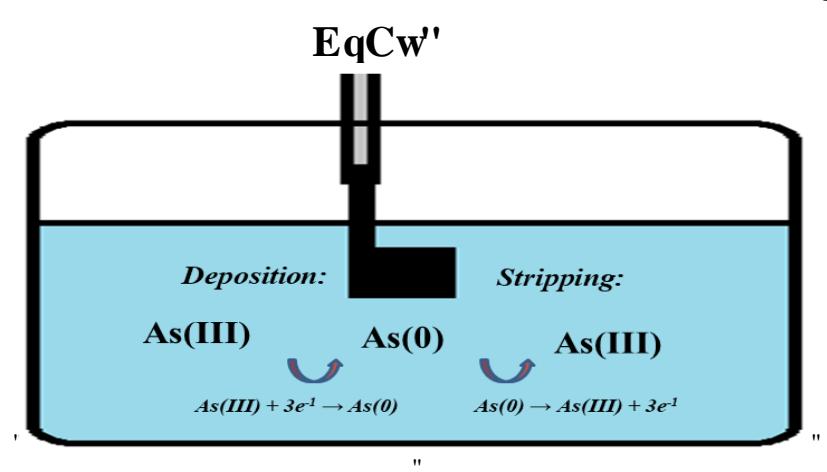
Cyclic voltammogram (CV) of CoAu(30s) electrode revealed its activity for detection of As(III) in aqueous media. Namely, CoAu gave a well-defined peak corresponding to As electrooxidation. The peak current density amounted to 1.73 mA cm-2 at -0.4 V, compared to only 0.15 mA cm-2 at the same potential in the absence of As ions in the solution. The influence of experimental conditions on arsenic detection was tested by recording CVs at different deposition potential (Ea) and different deposition time (ta) and subsequently these parameters optimised.
Arsenic determination was also tested in a real water sample that was diluted with NaHCO3 + Na2CO3 buffer (sample: buffer 75:25 vol.% ratio). CoAu(30s) electrode shows a well-defined arsenic oxidation peak in the real sample.
Within this work, CoAu(30s) electrode, prepared by simple and fast method and containing only 5.8 μg cm-2 of Au showed good activity for arsenic detection in aqueous media, in buffer as well as in a real sample. Thus, this electrode could be a potentially good sensor for arsenic detection in aqueous media.