
Diamond like carbon (DLC) films can have different properties depending on their atomic structure. The ratio between sp2 and sp3 bond hybridizations determines what kind of properties prevail in the film. High content of sp3 hybridization leads to properties similar to diamond, while greater amount of sp2 hybridized bonds leads to more graphitic material [1]. Atomic structure is influenced by the deposition conditions, therefore allowing to control properties of the films. This makes DLC thin films to possess great potential for applications in a variety of technological fields including wear resistance [2], medicine, optics [3] and particle accelerators [4]. An important application of DLC films in particle accelerators is related to the ability to reduce secondary electron yield. It was already shown in [4] that DLC films deposited with PECVD are characterized by secondary electron yield (SEY) coefficient of 1.5.
The objective of this research was to investigate optical properties and structure of an amorphous hydrogen-free carbon (a-C) films synthesized using different deposition methods (unbalanced magnetron sputtering (MS), high power impulse magnetron sputtering (HiPIMS) and conditions (bias voltage, deposition temperature, impulse power). Our previous research has shown that DLC films created by MS from graphite target had lower SEY coefficient in ca range of ~1-1.33 and we found direct correlation between SEY and Tauc gap and B parameter. Tauc optical band gap and B parameter of the films was determined from optical measurements (transmittance and reflectance) employing UV-VIS spectroscopy (Avantes system, 192-1100 nm, resolution – 1.4 nm). The absorption coefficient was calculated considering the thickness of the films determined with spectroscopic ellipsometer (GES5-E (Semilab)). Structure of the films was analysed with Raman scattering spectrometer inVia (Renishaw). The excitation beam from a diode laser of 532 nm wavelength was focused on the sample using a 50× objective (NA=0.75). Laser power at the sample surface was 3.5 mW.
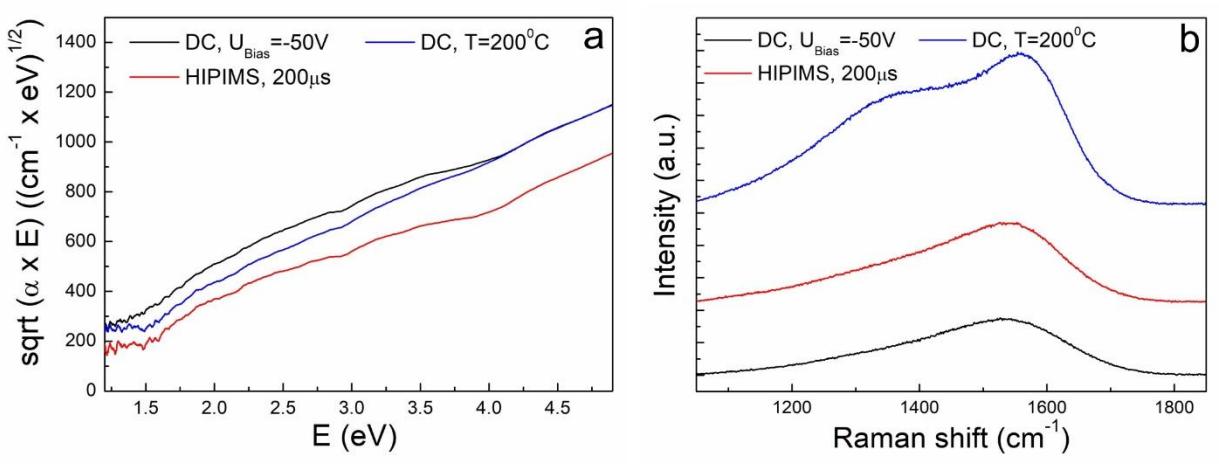
The analysis of optical properties revealed that the optical band gap (Tauc gap determined from the graphs in Fig. 1, a) varied in a range from 0.23 eV till 1,08 eV depending on the deposition conditions. We should emphasize that the widest bandgap was determined for the films deposited using HiPIMS and its value strongly depend on the pulse duration (band gap decreases with increase of pulse duration). Analysis of Raman spectra (Fig. 1, b) revealed similar tendency for HiPIMS deposited films, where the FWHM of G peak increased indicating higher sp3 content in the film.