
Ceramics play an important role in today's science and industry as it can withstand immense thermal, mechanical, chemical and other hazards. While 3D ceramic structures can be made in multitude of ways, optical 3D printing with subsequent heat treatment was proven to be one of the best methods combining simplicity of photolithography with freedom to choose any required 3D architecture.
In this work we disclose an advanced method for transforming silicon and zirconium metalorganic 3D nano-structures, prepared via sol-gel and laser multi-photon lithography, into a pure inorganic material. Such approach brings breakthrough for extremely small feature size (spatial resolution up to 60 nm) inorganic 3D structures [1]. In order to characterize the printed and heat treated 3D nano/micro structures the single-crystal diffraction technique was used. The phase purity of obtained structures are tunable, ranging from amorphous glass to ordered polycrystalline phases.
With a variable synthesis procedure of the initial resist and a post-heat treatment a range of inorganic phases for the 3D structures were achieved: amorphous glass, cristobalite, t-ZrO2, m-ZrO2, ZrSiO4 (Fig. 1).
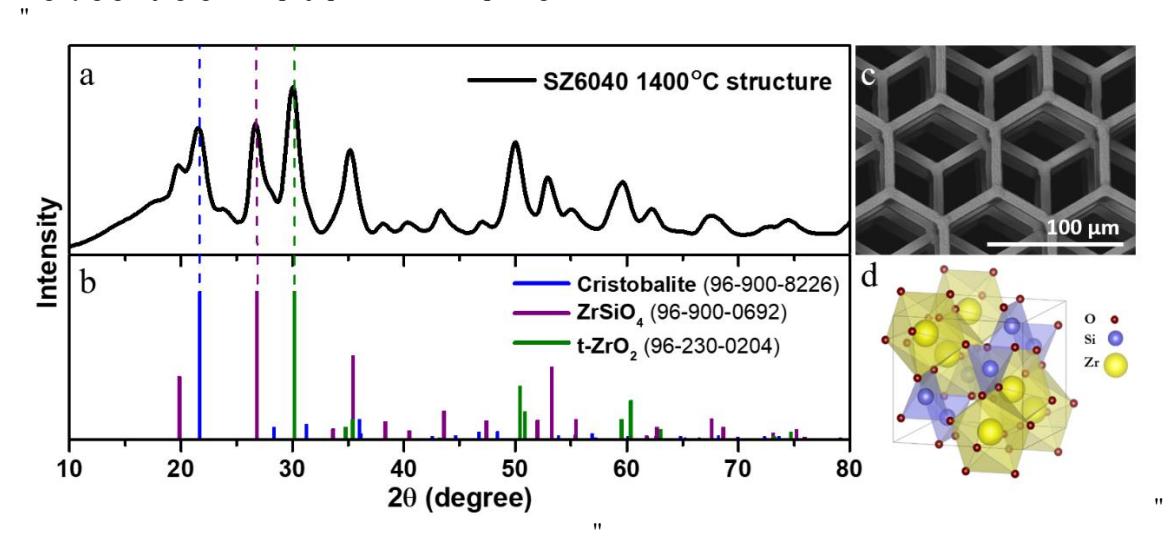
Overall, results show multi-photon lithography and thermal post-processing as a powerful tandem for creating ultra-resilient multifunctional 3D micro-/nano-scale ceramic crystalline structures.