
On theoretical level, multijunction solar cells have a potential to achieve over 60% power conversion efficiency. In practice, device with 47% efficiency has been fabricated based on III-V material and five-junction structure. However, extremely high cost of such multijunction devices inhibit their wide-spread application. In the recent years due to the unprecedent development of perovskite technology, two-junction solar cells comprising perovskite and well-established Si has demonstrated very promising results reaching 29% in 2020 [1], and opening the technological path for ultra-high and low-cost solar cells. To improve such tandem device further, adding additional junction with absorption edge at 0.7 eV can potentially add 5% of absolute efficiency.
In this work, we study underexplored class of materials for potential application in multijunction devices as bottom sub-cell (Figure 1). The selected compounds are from the chalcogenide-perovskite material group, containing earth-abundant chemical elements and compatible with low-cost synthesis methods are predicted to have low band gap (< 0.0 eV) [2]. Chalcogenide-perovskites have a general compound formula ABX3, where in our study A=Ca, Sr, Sn; B=Ti, Zr, Sn; X=S,Se. Samples were synthesized via solid state reaction (Figure 1 inset) and characterized by x-ray diffraction method to study chalcogenide-perovskite thermodynamic stability and crystal structure.
We found that many chalcogenide-perovskites are not stable and do not form under normal (without transport agent or catalysis) conditions. In contrast to halogen and oxide perovskites, the structure of chalcogenide-perovskites cannot be predicted according to the tolerance factor ($t$), i.e., when $t$ is close to unity, adopted structure is not cubic. This shows that atomic bonding in chalcogenide-perovskites is more covalent than ionic in nature and therefore usually adopt one of the following lower symmetry crystal structure: needle-like (prototype NH4CdCl3), hexagonal (prototype BaNiO3) or distorted perovskite (prototype GdFeO3).
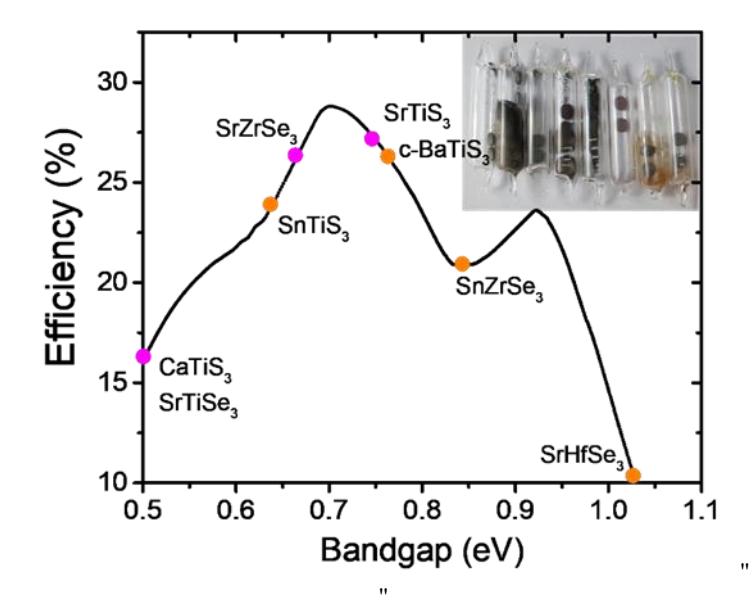
Among studied compounds, we found that SrTiS3 is stable under ambient conditions, crystalizes into hexagonal (prototype BaNiO3) and non-stoichiometric (Sr1.2Ti0.8S3) structure and with a bang gap at around 0.65 eV. On the other hand, there also other potential chalcogenide-perovskites where chemical composition can be fine-tuned by cationic or anionic substitution to achieve optimal 0.7 eV band gap.