Nowadays, InGaN light emitting diodes (LEDs) are widely used for application in solid-state lighting and large area displays. The commercial devices are mostly grown on polar c-plane substrates, however, the optical properties of InGaN quantum wells (QWs) in such devices are strongly affected by the internal electric field along the polar growth direction [1]. Nonpolar (a- or m-plane) InGaN/GaN multiple quantum wells (MQWs) attract attention due to the absence of polarization-related electric field, which should improve the optical performance, and capability to emit highly polarised light [2].
In this work, we present the photoluminescence study of nonpolar InGaN/GaN MQWs with the main focus on the dynamics of double-band structure. We have studied seven (m-plane) InGaN/GaN samples with different indium content or QW width. Samples were grown on sapphire substrates using metalorganic chemical vapor deposition (MOCVD). Measurements were performed under the excitation power density varied from 3.6 W/cm2 to 13.4 MW/cm2 in wide temperature range of 8 - 300 K.
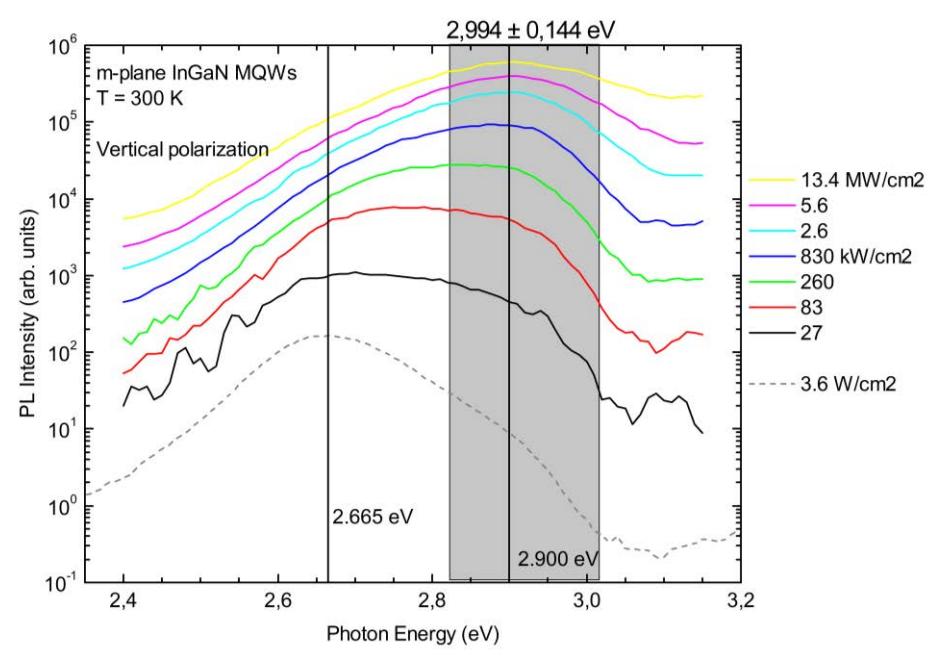
The typical double-band PL spectrum of the nonpolar InGaN/GaN samples can be clearly observed at low excitation (3.6 W/m2) when the lower-energy band dominates (see Fig. 1). As the excitation power density is increased, the higher-energy band grows faster, and the clear separation between the two peaks disappears. Meanwhile, at the highest excitation, the higher energy band dominates. Similar behaviour of the two bands is also observed at lower temperatures of 8 K and 150 K. Multiple peaks were also observed in the PL spectra of previously studied polar InGaN/GaN samples.
The nature of the two PL bands is not yet well understood and several interpretations are under consideration: the emission from narrow sidewall MQWs in V-pits [3] or by the slowly decaying tail of the density of states due to potential fluctuations [4]. The observed blue shift of the peaks is attributed to the quantum Stark effect and the filling of the localized states [5]. The simple estimation of quantized energy levels in the InGaN QWs (indicated by the shaded region in Fig. 1) allowed us to attribute the higher-energy PL band to the transitions between the lowest levels. The lower-energy band is then assigned to the recombination of localized carriers.