
Non-polar and semi-polar Group-III nitrides are of great interest due to their potentially high quantum efficiency. Photonic devices based on nitride quantum wells (QWs) with reduced or even eliminated internal electric fields demonstrate better quality, specifically better radiation efficiency, charge transport, optical gain; however, spatial variations of light emission still significantly affect the performance of such devices [1]. Therefore, there is a need to investigate in more detail the microscopic-scale optical properties of non-polar quantum structures and their relations with structural quality and growth conditions.
This work is dedicated to investigation of the spatial uniformity of luminescence of InGaN multiple quantum wells grown on different crystallographic planes by Metal Organic Chemical Vapour Deposition (MOCVD) technology. In order to determine InGaN luminescence properties and their correlations with structural defects, Scanning Electron Microscopy (SEM) as well as both spatial- and time- resolved cathodoluminescence (CL) characterization were employed. SEM allows to evaluate defects density at different sample areas, while CL analysis is convenient in order to get an insight into materials properties as bandgap and carrier dynamics with high spatial and temporal resolutions.
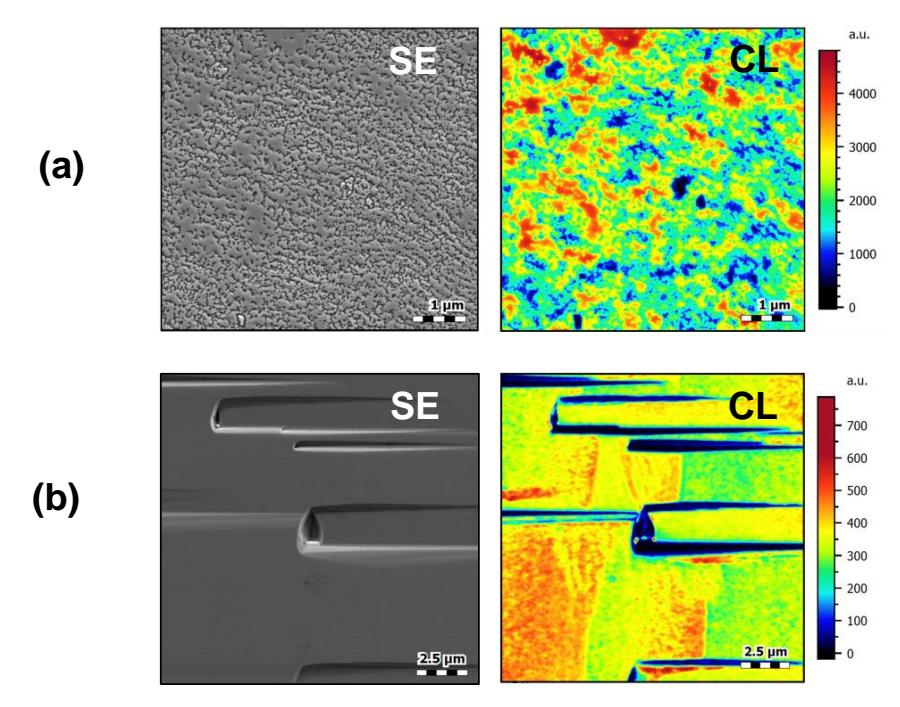
The measurements revealed that the spatial distribution of CL intensity is inhomogeneous and correlates with surface topography in both polar and non-polar structures (fig.1). In c-plane InGaN quantum wells the luminescence properties are strongly affected by high density of v-pits (~1010 cm-2) and trench defects. Moreover, the CL decay time shows positive correlation with the emission intensity. In case of m-plane sample, the comparison of Secondary Electron (SE) image and CL intensity distribution indicates that scattered step bunches were formed, possibly due to substrate imperfections. In such defects, quantum structures of other than m-plane polarity occur, which leads to inhomogeneous Indium distribution and spatial variation in the light emission. Furthermore, the CL decay time in m-plane structure did not show such a pronounced correlation with the emission intensity as in polar InGaN.