
Any irreversible change of coating, surface or bulk of an optical component, that is induced by exposing material to laser light is called laser induced damage. Laser induced damage threshold (LIDT) defines the fluence of radiation, that optical element can withstand without suffering damage. For various optical components it is usually given as single pulse fluence, but in reality, damage can occur at lower fluences after exposition of many pulses – this effect, known as accumulation, will be the main focus of presented investigation.
Change of differential absorption spectra of an element after excitation with femtosecond pulses was chosen as indication of irreversible damage. For that, a typical pump-probe spectroscopy measurement was modified to register spectra after each excitation pulse and then calculate the difference from the first pulse to hit the sample:
$$ \delta A(\lambda, N) = \Delta A_0 - \Delta A_N, \tag{1} $$where $\lambda$ is wavelength, N – number of pulses and $\Delta A$ – differential absorption. Sequential pulse trains of precisely 100 pulses per each would reach the material and then we simply calculate how many pulses were needed to induce optical damage.
Measurements were performed with 0.2mm thickness fused silica covering glass. In Fig. 1 (a) a typical set of results is shown. The moment of damage, when $\delta A$ becomes greater then 0 and grows further (so we don't confuse it with noises) is clearly distinctive from the graph. Because threshold dependency on pulse count is rather scattered, we can conclude that optical damage is a probabilistic process.
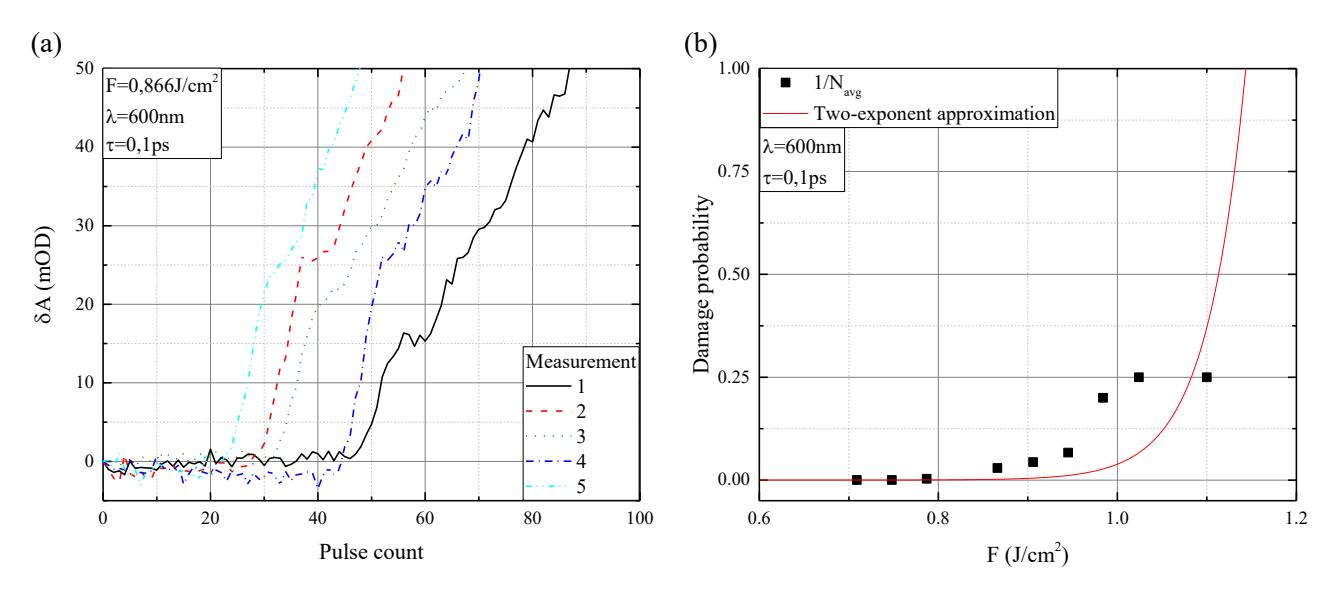
An inverse of average count of pulses Navg required to induce optical damage can be considered as a probability to damage the sample with the very first pulse. In Fig. 1 (b) that probability's dependence on fluence is plotted and results are approximated with two-exponent function. This implies that there are two stages of damage probability and at higher fluences it is more dependent on density of surfaces defects, that can act as damage precursors, rather than properties of material itself. The approximation also allows to evaluate at what minimal fluence a certain sample would definitely be damaged (probability is equal to 1) – in our case it was Fmin = 1.143J/cm2.