Finding new methods to obtain higher average powers and shorter pulse durations is an important topic of laser physics research [1]. One of the ways to achieve such parameters of light is amplification of ultrashort pulses with fiber amplifiers. Intensive studies and improvements on Yb-doped fibers has led to the demonstration of many advantageous properties if compared to conventional bulk solid-state systems. Due to their geometry and design, Yb-doped fiber amplifiers feature outstanding thermo-optical properties, large gain bandwidth and high optical pumping efficiency. However, the drawback of amplification of ultrashort pulses in fibers is the long confined propagation length that limits both the power and the energy scaling due to nonlinear pulse distortions [2]. In fiber chirped pulse amplification (FCPA) system pulses are temporally stretched before amplification, to reduce nonlinear effects in the amplifier, and then compressed to ~200 fs [3]. On the other hand, nonlinear amplification methods - parabolic pulse amplification, pre chirp managed (PCMA) and gain managed amplification (GMA), clearly denote how fiber nonlinearity can be harnessed, rather than being a limiting factor: amplified pulses have broadened spectrum, exhibit linear chirp and can be effectively compressed to <50 fs [3, 4]. These amplification techniques nowadays are frequently realized by using large mode area (LMA) double cladding photonic crystal rod-type fiber amplifiers in which nonlinear effects are significantly reduced and single mode regime coupled with high optical efficiency enables amplification of ultrashort pulses up to 10 - 100 W of average power [5].
Exactly this type of fiber amplifier is used in this work. Single pass fiber amplifier system was designed and utilized for amplification of femtosecond pulses from Yb:KGW oscillator “Flint” (“Light Conversion"). Spatial, temporal and energy characteristics of amplified light was measured. Yb-doped LMA double-clad polarization maintaining photonic crystal rod-type fiber (“NKT Photonics”) was used for the amplification.
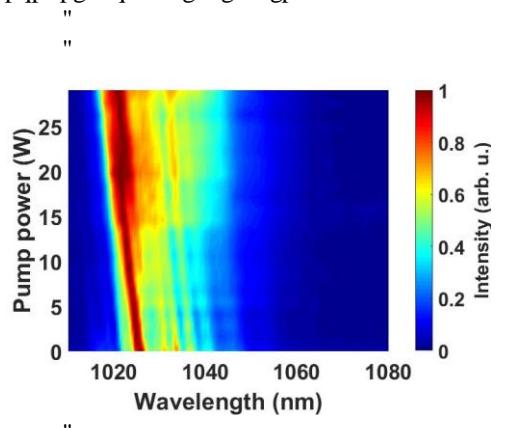
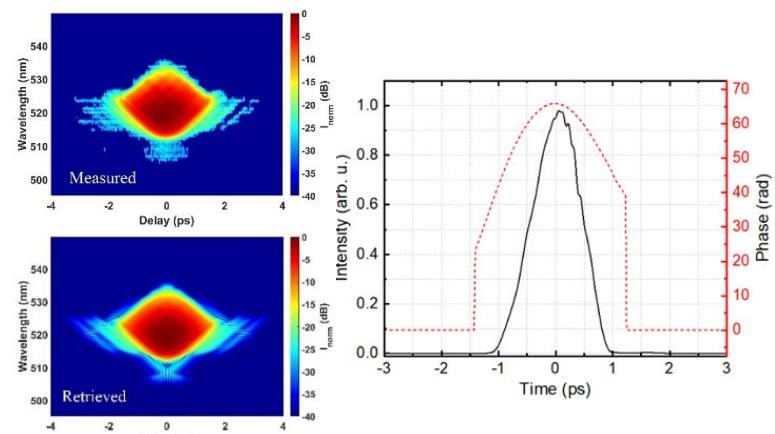
It was determined that maximum average output power from the amplifier system was 19,5 W when the pump power was 29 W with the seed power of 4 W. Highest core-clad power ratio (CCR) of 0,935 (11,6 dB) was reached at maximum output power, while polarization contrast ratio (PER) of the amplifier was 19,4 dB. Due to self-phase modulation effect, modest spectral broadening of the amplified pulses was observed (Fig. 1): root mean square spectral width increased by 3 – 4 nm compared to input seed spectrum. Second harmonic FROG measurements showed that amplified pulses broadened in time from 83 fs from the oscillator to 864 fs – 1,07 ps at the fiber output (Fig. 2). Also, spectral and temporal broadening of pulses depended on seed polarization. In all cases amplified pulses exhibited quadratic temporal phase therefore the pulse chirp was linear and can be effectively compensated down to duration that is shorter than oscillator pulse duration. Required group delay dispersion for dispersion compensation was also calculated. Finally, it was evaluated that, in this case, chirped mirrors are most suitable for optimal compression of amplified pulses. Final amplifier system will be used as a high power and high pulse quality laser system for further nonlinear optics experiments.