
Optical coatings are used to direct and control laser-generated radiation. At present, there are increasing demands on high performance coatings, featuring stability of their optical parameters and the highest possible resistance to laser radiation. Sculptured thin films may be used to form coatings with a high laser-induced damage threshold (LIDT). Such coatings have a porous nanostructure and are formed by rotating the substrate at an oblique angle in terms of vapor flux. However, porosity causes the coating to absorb water and other harmful particles from the environment, thus insolation of the coating or all element must be implemented [1].
The aim of this study was to investigate the dependence of the optical resistance of nanostructured silicon oxide-based Bragg mirrors on sample storage conditions. The structures of the multilayer coating (50 layers) were formed using electron beam evaporation technology at zero-degree angle (dense, high refractive index layer) and seventy-degree angle (porous, low refractive index layer). To determine the environmental impact of porous coatings, three samples were placed in an oxygen environment (by injecting O2 gas into a plastic bag), others three in a dry air environment: in a glass desiccator in which the coatings were held with silica gel to maintain moisture as low as possible. Subsequently, one coating was removed from the initial environments each week and spectral and laser resistance measurements were performed.
LIDT test 1-on-1 measurements were made using ND: YAG laser pulses with parameters: $\lambda$ = 355 nm, $\tau$ 3 ns, spot diameter 70 µm. The obtained results show that the LIDT of the sculptural coatings kept in dry air for three weeks is larger and reaches 51.5 J/cm2 (see Fig. 1) while a coating stored in the oxygen environment for the same period of time - 11.5 J/cm2.
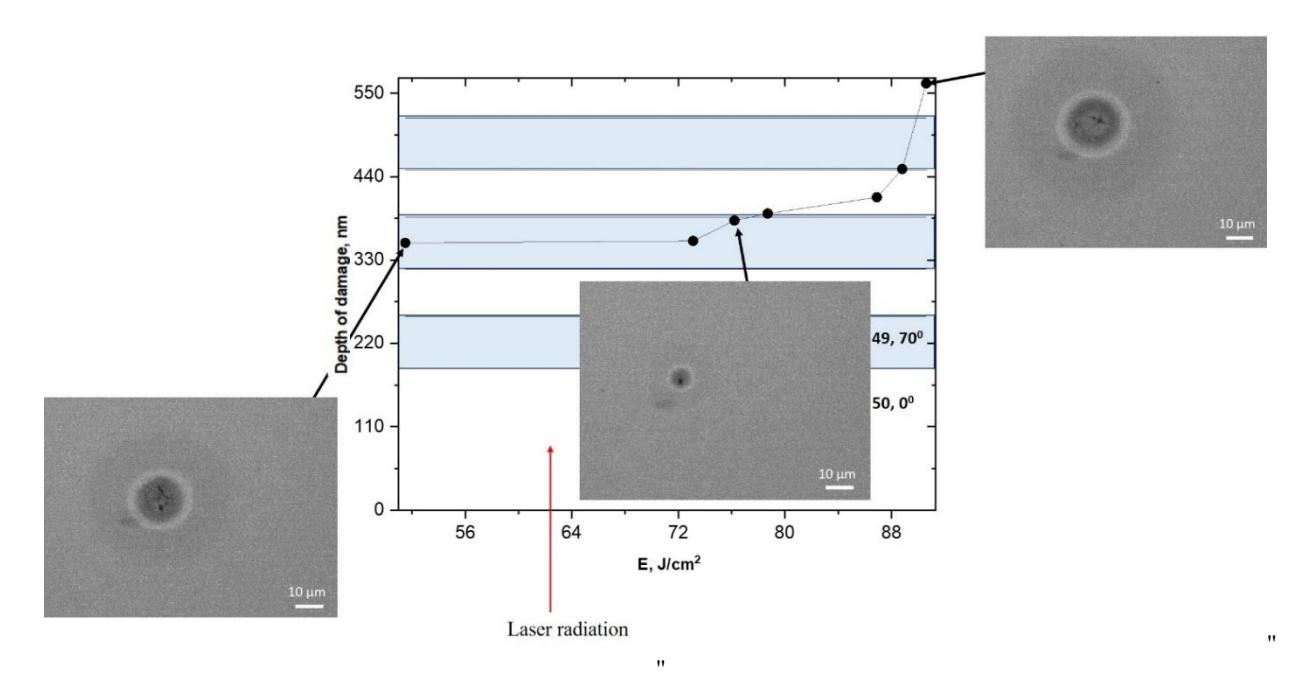
Thus, a sculptural coating stored in a dry air environment is more resistant to laser radiation and resistance remains constant, because the coatings stored in an only oxygen environment have the oxygen vacancy's, which caused damage by nanosecond pulses [2]. This research showed that a dry air environment is better place to store porous silica based multilayer coatings than an only oxygen environment.