In particle physics, even with massive amount of data collected by the current detectors, some particles are elusive. Such are neutrinos. Neutrinos, while common, only couple weakly to all known matter. This means that interactions are very rare, even in the presence of dense detectors.
A way to look for them, without a direct detection, is through momentum balance. In a beam all particles are roughly going along the beam axis, with very little if any transverse momentum. This means that the full transverse momentum of a collision is zero. If this is not the case, there are missing particles in the detector. These could likely be neutrinos.
This work analyzes Z boson decays into a pair of neutrinos (Z -> vv). Since there is no pure Z boson source, the biggest machine ever built, the LHC (Large Hadron Collider), serves as the best all-purpose source. LHC provides protons at initial state. While pp -> vv is a possible and a very likely process, it is difficult to detect. When the outcome is completely undetectable how can you be sure the process even happened. Therefore, some detectable particles are needed in the final state. Leptons are clean and easily detectable detector objects that can simplify the neutrino hunt. For that reason, the initial state containing a pair of charged leptons in addition to neutrinos is chosen i.e., the process pp -> llvv.
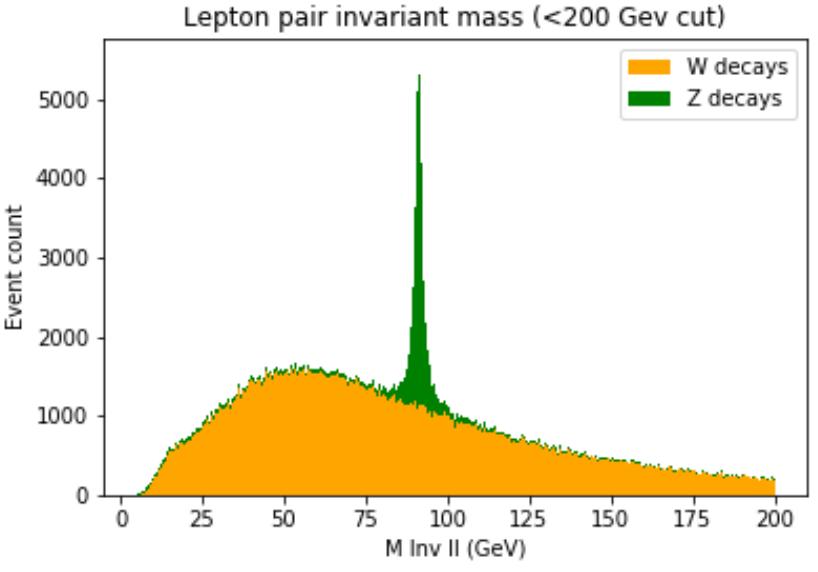
Now the problem comes in distinguishing the Z boson decays from the rest of the processes with the same initial and final states. This is achieved through the use of artificial intelligence. To be specific a neural network based classifier. This classifier was constructed using TensorFlow [1] and Keras [2]. But an untrained neural network is useless. To apply it to any real data it needs to be trained first. Training data is generated using a simulation software, in particular, Madgraph [3]. A good candidate process with llvv final states is pp -> ZZ -> llvv, here we can take advantage of the invariant mass of the lepton pairs that should be around the Z boson mass, as is seen in Fig. 1. Other processes (with llvv final states) include W bosons and their subsequent decays, which are around 10 times more likely, but the clear peak seen in Fig. 1 allows us to cut the data in such a way that the event counts are very similar. A classifier can then be trained to further discriminate the underlying processes.