
Oncological diseases are one of the most common causes of death worldwide. According to the World Health Organization, over 18 million new cases of various cancers were recorded in 2018 [1]. The limited range of solutions for fighting oncological diseases encourages searching for alternative, more effective anticancer treatment strategies. One of the novel therapeutic approaches uses electroporation (EP) in combination with chemotherapeutics, calcium ions or other drugs. Pulsed electric fields (PEF) create nanoscale aqueous membrane pores, facilitating rapid intracellular, usually impermeable drug molecule delivery [2].
In this study tumors in C57BL/6J and BALB/c mice were induced by subcutaneously injecting LLC1 and SP2/0 cells respectively. When tumors reached 100 mm3, treatment was applied as described below. For C57BL/6J carcinoma tumor ablation, bleomycin electrochemotherapy (ECT) was used with four different conditions of high-frequency nanosecond EP*1 in comparison with ESOPE*2 procedure. BALB/c mice tumors were ablated with calcium electroporation (CaEP) (4.5 kV/cm x 600ns x 500/1 MHz) with or without dendritic cells vaccine (DCV) (Fig.1). Mice survival and development of antibodies (Ab) against tumor cells were assessed during the experiment.
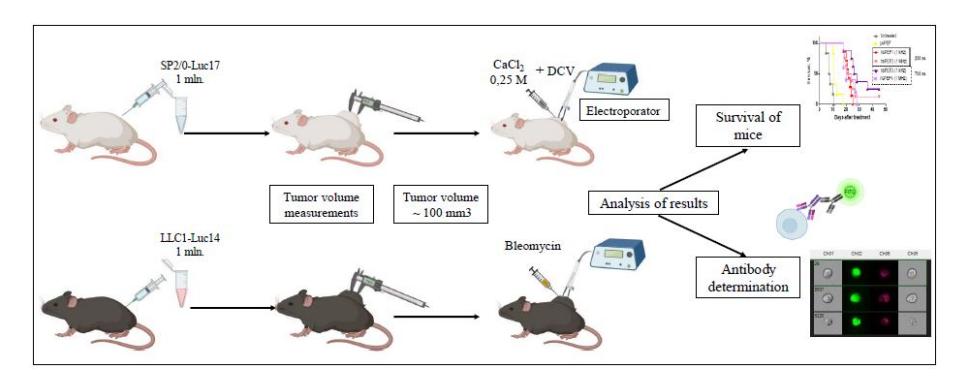
We showed that CaEP and ECT of tumors prolonged the lifespan of BALB/c and C57BL/6J mice. Tumor-bearing untreated BALB/c mice median survival was 8 days while CaEP and CaEP + DCV-treated mice median survival was 32 and 30 days, respectively. Untreated C57BL/6J tumor-bearing mice median survival was 7.5 days, whereas EP-treated mice median survival was approximately 2-3 times longer (nsPEF1 – 11 days; nsPEF2 – 22 days, nsPEF3 – 22.56 days, nsPEF4 - 27 days, and ESOPE-treated - 20 days).
Tumor-bearing untreated BALB/c mice did not develop Ab to SP2/0 tumor cells. The lifespan of untreated mice was up to 11 days. Probably, the Ab did not develop due to the rapid growth of tumors, resulting in reduced mice lifespan. Anti-Sp2/0 Ab in treated BALB/c mice were assessed at 0, 10, 20 and 30 days after the treatment. The Ab against tumor cells were detected not earlier than 20 days after the treatment. Only 30 days after treatment, CaEP + DCV-treated mice had higher level of Ab compared to only CaEP-treated mice.
We observed that tumor-bearing untreated C57BL/6J mice develop Ab against LLC1 tumor cells 10 days after development of the tumors. However, the levels of Ab in ECT-treated mice were higher. The levels of anti-LLC1 Ab have increased in nsPEF1, nsPEF2, nsPEF3 and nsPEF4-treated mice compared with the untreated and ESOPE-treated mice.
Our study has shown the EP, by itself or in combination with other drugs, to prolong the lifespan of tumor-bearing mice, resulting in increased anti-tumor Ab levels. These results suggest that anti-cancer Ab may be on the frontline in the fight against cancer. Although, further studies need to be done to confirm this hypothesis.
*1 nsPEF1 (3.5 kV/cm x 200 ns x 200 /1 kHz); nsPEF2 (3.5 kV/cm x 200 ns x 200 /1 MHz); nsPEF3 (3.5 kV/cm x 700 ns x 200 /1 kHz); nsPEF4 (3.5 kV/cm x 700 ns x 200 /1 MHz).*2ESOPE - European standard operating procedures for electrochemotherapy (1.3 kV/cm x 100 μs x 8 /1 Hz).