
So far, no standards for acclimation guidelines have been established for acceptable acclimation periods prior to behavioural testing with fish. The acclimation period taken by fish to recover from stress after transference to new experimental conditions may play a crucial role in deepening the understanding of behavioural characteristics of the test species, especially in short-term toxicity testing [1,2].
In the present study, we investigated the effect of acclimation period (4 h) on swimming behaviour (locomotor activity) of rainbow trout (Oncorhynchus mykiss) and Atlantic salmon (Salmo salar). Specifically, we explored fish behavioural patterns based on specific endpoints (average, maximum and angular velocity) during the acclimation period and determined the acclimation period suitable for the test fish species. We expected that after transference to their new experimental conditions, fish individuals would experience stress followed by a period of exploration and increased intensity of fish locomotor activity before settling to more stable (baseline) activity levels.
The locomotor activity of O. mykiss and S. salar significantly varied during the 4-h-acclimation period (Fig. 1). Based on the tested endpoints, the locomotor activity of both species significantly decreased over time. According to average and angular velocity endpoints, the locomotor activity of O. mykiss significantly decreased (p < 0.004) during 3-4 h of acclimation. A similar behavioural tendency to O. mykiss was observed in the assessed endpoints of S. salar locomotor activity. According to average velocity a significant decrease (p < 0.001) in locomotor activity was determined during 3-4 h, while changes in angular velocity data were established much earlier, i.e. during 2 h of acclimation. However, no significant behavioural differences between test species was found. These results revealed that in order to adjust fish activity to more stable baseline levels, acclimation of O. mykiss and S. salar should last at least for 2 h.
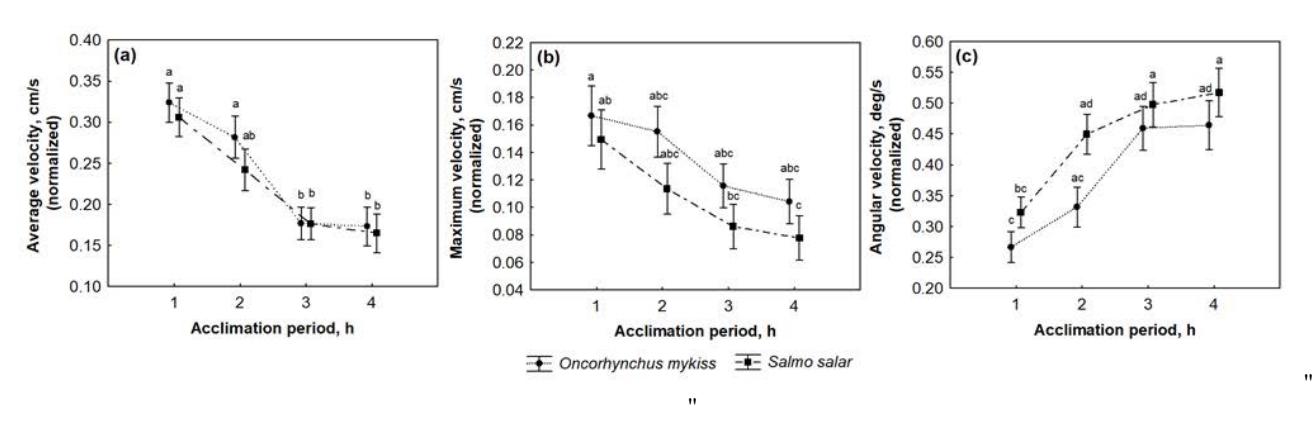
Since behavioural testing is not clearly standardized and experimental setup may depend on the purpose of the study, acclimation period setup in toxicity testing remains an important issue across studies. In cases of inappropriate duration of fish acclimation (e.g. duration is too short), the observed behaviour in fish may not reflect the actual impact of toxicants due to the interference of effects caused by stressors (e.g. new environment or toxicants) leading to high behavioural variability of fish. The results of this study revealed that the appropriate acclimation period on salmonid species is important in managing fish stress before the onset of behavioural observations. We consider it important to the acclimation period suitable for specific fish species before starting actual toxicity experiments.