Perovskites emerged in the scientific world because of their attractive optoelectrical properties with promising applications in solar cells, LEDs and photodetectors. Depending on the application field, these material properties can be changed by simply adjusting their composition [1-2]. This lets perovskites exist in diverse structural forms, including 3D, 2D, quasi-2D, each exhibiting unique charge carrier dynamics relevant to devices performance. Two distinct processes in perovskite materials can be distinguished: charge carrier migration and excitation energy migration [3]. Understanding which one is dominant in material is crucial both for fundamental knowledge and for educated design and optimization of devices [2]. This study investigates the effects of dimensionality on charge carrier migration as the perovskite structure transitions from fully 3D to quasi-2D and 2D configurations.
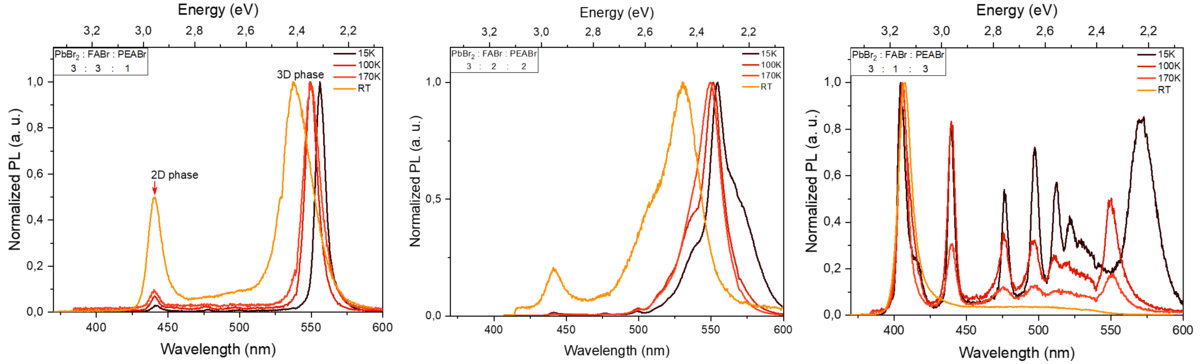
There were five different perovskites. By changing the ratio of smaller and bigger organic cations (PEA\(^{+}\) and FA\(^{+}\)) in perovskite lattice, we analyzed which migration mechanism takes place using photoluminescence at different temperatures and pump-probe experiments. In purely 2D perovskite (low n Ruddlesden–Popper phase) stable excitons form in 2D materials even at room temperature. The absence of additional peaks or spectral changes suggests that photo-excitations recombine where they are generated rather than migrating to distinct lower-energy sites. Quasi-2D perovskites (a mixture of phases with different layer number n) show that the emission is dominated by the lowest-bandgap (largest-n) domains, which appear as the most red-shifted PL band. Therefore, cooling inhibits the funneling process, so excitons/carriers become “trapped” in the higher-bandgap domains and radiatively recombine there, instead of all funneling into the lowest-bandgap sites. This is observed as distinct PL peaks corresponding to n = 1, 2, 3, etc. By comparing 2D, quasi-2D, and 3D cases, we see a continuum: from tightly bound excitons that stay put (2D), to hybrid systems where carriers relocate to favorable sites (quasi-2D), to 3D free carriers moving in a uniform lattice.