Perovskites have been shown to be a promising material in photovoltaics, where single junction perovskite solar cells have reached efficiencies of 26.1% [1]. CsPbCl\(_3\) perovskites doped with Yb\(^{3+}\) ions are capable of quantum cutting (QC), where one perovskite exciton is converted into two ytterbium excitations [2]. This phenomenon can be used in luminescent solar converters to efficiently turn ultraviolet light into near infrared light, which has been shown to increase commercial solar cell efficiency [3]. The main problem holding back commercial use of these materials is the toxic and hard to scale methods of synthesis, primarily hot injection methods [4]. We used a modified facile mechanosynthesis method [5], where only simple grinding and annealing are required to synthesize perovskite powders. We are exploring energy transfer mechanisms between the perovskite and Yb\(^{3+}\) ions by applying steady state and time resolved spectroscopy methods.
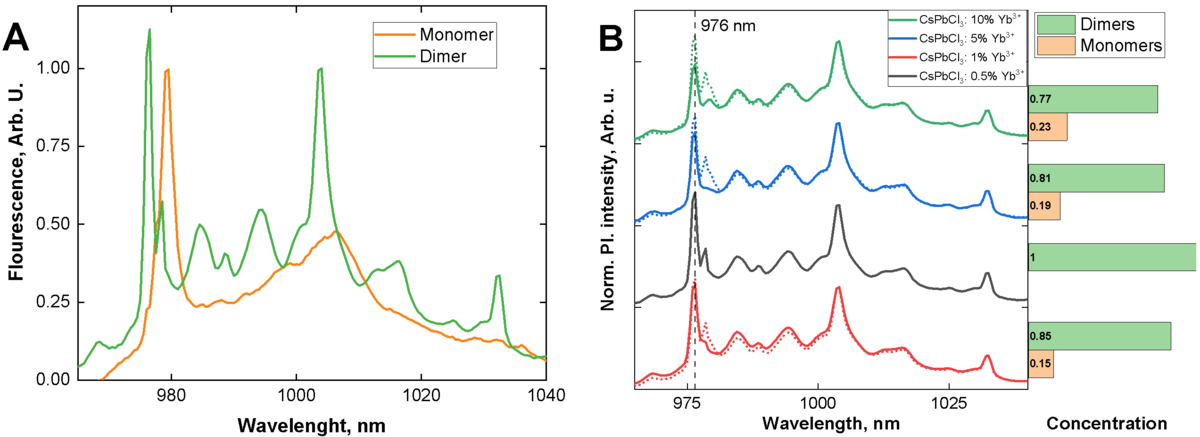
We investigate low temperature photoluminescence (PL) spectra of CsPb\(_{1-1.5x}\)Yb\(_x\)Cl\(_3\) dopped with different Yb\(^{3+}\) concentrations, where two ytterbium species with different optical properties should form: dimers and monomers [6]. Dimers are two adjacent Yb\(^{3+}\) ions in the perovskite that can undergo QC, while monomers are solitary Yb\(^{3+}\) ions that cannot undergo QC and probably are not incorporated into the perovskite lattice. By mathematically manipulating Yb doped perovskite PL spectra excited at two different wavelengths, 375 and 940 nm, we derived PL spectrum for each of the Yb species (fig. 1A). Mathematical methods were used to approximate perovskite dopped with different Yb\(^{3+}\) concentrations PL upon 375 nm excitation from the obtained dimer and monomer spectra (fig. 1B). The proportion of monomers increases with Yb\(^{3+}\) concentration (fig. 1B), which suggests that at higher concentrations Yb\(^{3+}\) ions are not as efficiently incorporated into the lattice or energy is being transferred from the dimers to monomers. At low concentrations we observe more Yb\(^{3+}\) dimers due to optimal ion concentration for the incorporation into the lattice and low migration limited quenching. The differences in intensities of 976 nm peak (fig. 1B), are attributed to reabsorption by the monomers. Further experiments are being conducted using perovskite quantum dots, which should create different ratios of species. This would allow more precise identification of their characteristics.