Liquid crystal elastomers (LCEs) are smart materials that combine the orientational order of liquid crystals with the elasticity of elastomers, allowing them to undergo reversible deformations in response to stimuli such as heat, light, or electric fields. Their actuation - bending, twisting, or shrinking - can be programmed during the fabrication stage, by aligning liquid crystal molecules before polymerization, making them ideal for applications in soft robotics and micromotors [1].
Conventional methods for controlling LC alignment, such as surface alignment through rubbing or using external fields, offer limited spatial control over molecular alignment [2]. To overcome these constraints, we explore direct laser writing (DLW), a high-precision, two-photon lithography technique that enables the fabrication of intricate 3D micro- and nanostructures via selective resist photopolymerization. While DLW has been used to create LCE microstructures, previous implementations have relied on additional alignment techniques (e.g. rubbing or photopatterning), to create anisotropic material.
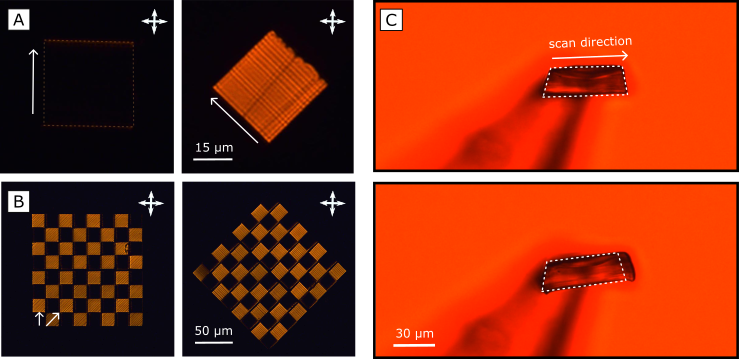
Our research demonstrates that line-by-line laser scanning during polymerization can directly control LC molecule orientation, likely due to interactions between polymerized regions and neighboring LC molecules. This enables the fabrication of LCE microstructures with customized birefringence patterns and reversible deformation capabilities (Fig. 1). Notably, this method allows fabrication on challenging surfaces, such as the end face of an optical fiber. Additionally, it provides greater control over local molecular alignment, enabling the creation of complex director patterns without requiring additional processing steps. This direct-writing approach expands the possibilities for integrating LCEs into micro-optical and micro-mechanical systems with precise structural and functional customization.