
Gallium Nitride (GaN) is a wide-direct-bandgap semiconductor material widely utilized in high-voltage electronics, space applications, and medical diagnostic equipment due to its excellent radiation hardness and thermal stability [1-3]. The dual response capability of GaN makes it an attractive candidate for radiation monitoring and high-energy physics experiments, such as ALICE and CMS detectors at CERN [4]. A crucial advantage of GaN-based devices is their potential for optoelectronic characteristic recovery after exposure to radiation, enabling annealing-based restoration instead of costly device replacements. This is particularly beneficial for applications in extreme environments such as space, nuclear reactors, and particle accelerators, where radiation damage can degrade detector performance over time.
In this study, various optical and electrical characterization techniques were employed to investigate the isochronal annealing effects on proton-irradiated metal-organic chemical vapor deposition (MOCVD) GaN. Figure 1a presents the microwave photoconductivity (MW-PC) signal for pristine and irradiated samples during annealing, while Figure 1b displays the time-integrated photoluminescence (TI-PL) spectra for the same samples. 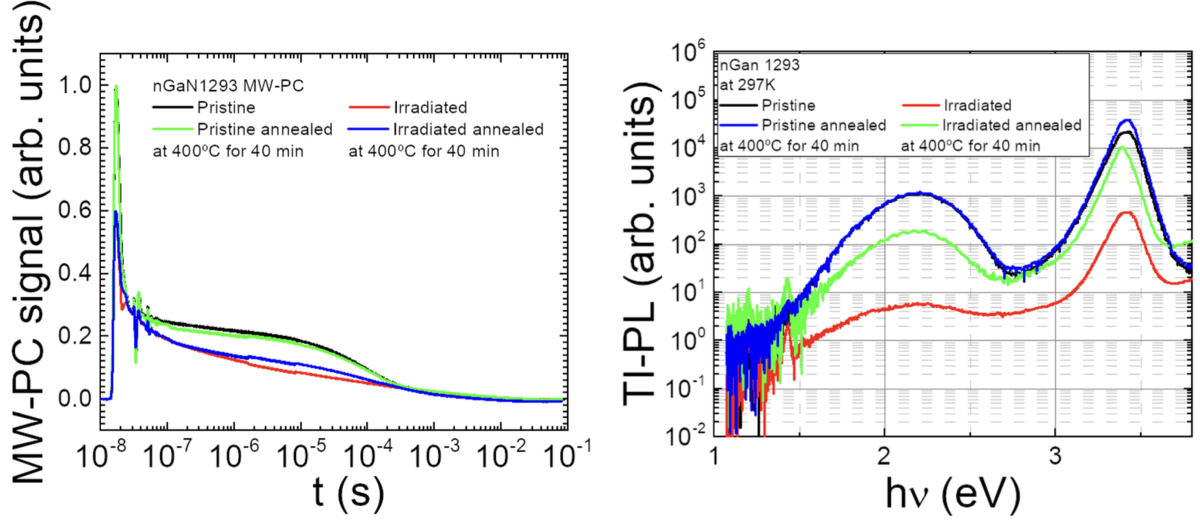
ANNEALING EFFECTS ON RADIATION-DAMAGED GaN DETECTORS FOR SPACE AND HIGH-ENERGY APPLICATIONS
Mykolas Strigūnas1, Jevgenij Pavlov1, Tomas Čeponis1
1 Institute of Photonics and Nanotechnology, Vilnius University, Vilnius, Lithuania
[1] T. Ceponis, M. Burkanas, A. Cicinas, L. Deveikis, J. Pavlov, V. Rumbauskas, J. Venius, E. Gaubas, Combined techniques for recovery of radiation damaged detectors, Materials Science in Semiconductor Processing, 2023, 107863
[2] M. A. Reshchikov, D. O. Demchenko, D. Ye, O. Andrieiev, M. Vorobiov, K. Grabianska, M. Zajac, P. Nita, M. Iwinska, M. Bockowski, B. McEwen, F. Shahedipour-Sandvik, The effect of annealing on photoluminescence from defects in ammonothermal GaN. J. Appl. Phys. 2022; 131 (3): 035704.
[3] T. Ceponis, K. Badokas, L. Deveikis, J. Pavlov,V. Rumbauskas, V. Kovalevskij, S. Stanionyte, G. Tamulaitis and E. Gaubas, Evolution of Scintillation and Electrical Characteristics of AlGaN Double- Response Sensors During Proton Irradiation, Sensors 2019, 19, 3388
[4] J. Wang, P., Mulligan; L. Brillson, L. R. Cao. Review of using gallium nitride for ionizing radiation detection. Appl. Phys. Rev. 2025, 2, 031102