The need to reduce electromagnetic (EM) reflection is essential for applications in stealth technology, absorbing high power EM radiation for protection and minimal visibility to detection systems. Traditional metallic microwave metasurfaces are constrained by their rigidity, weight, and thickness. Recent studies have shown that flexible metasurfaces on textile substrates can provide effective absorption while maintaining adaptability to curved surfaces, making them suitable for applications where a substantial contribution to shielding should come from absorption [1, 2].
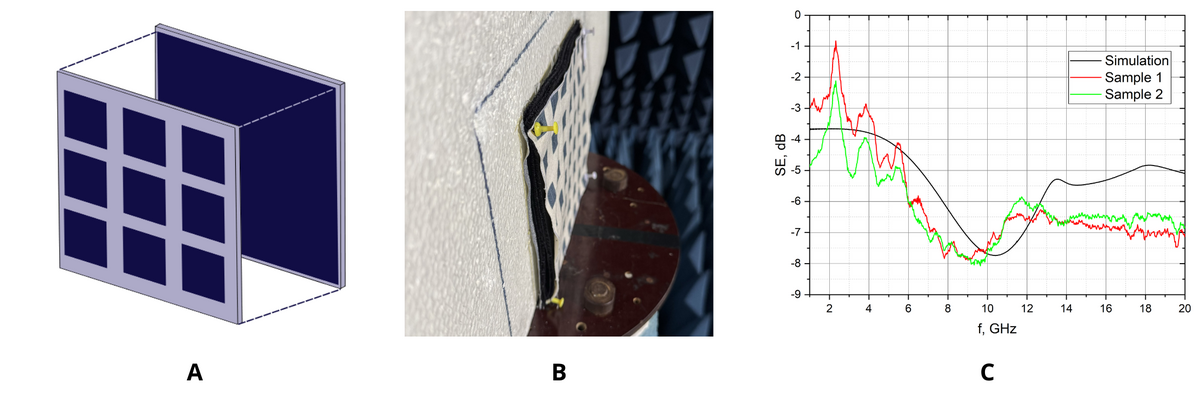
This study presents a flexible Salisbury screen design with metasurface [Fig. 1 (A)], aimed at reducing EM wave reflections in microwave range. The structure [Fig. 2 (B)] consists of a textile substrate fully coated with conductive paste containing PEDOT:PSS, followed by a thick non-conductive textile layer and a second textile layer coated with a metasurface made from the same paste. Reflections in structure are minimized because of destructive interference, significantly improving the overall absorption at targeted frequencies. The dimensions of the metasurface unit cell and gap size between layers are selected in such a way that their resonant frequencies would match, maximizing destructive interference for effective reflection reduction. The metasurface array consisted of 13×13 mm conductive squares arranged in a 26 mm period and a fully coated structure. The surface resistivities of layers ranged from 40 \(\Omega\)/sq to 300 \(\Omega\)/sq. The gaps between the layers varied from 3 mm to 9 mm. The fabric thickness was considered to be H=0.1 mm, with a dielectric permittivity of \(\varepsilon\)=1.6, and the conductive polymer thickness was h=0.01 mm.
The shielding efficiency of each individual layer was measured to assess the conductivity, quality, and performance of each layer. Experimental results were compared with CST Studio simulations to determine surface conductivity and identify the most effective layer configurations for reflection reduction. Using the conductivity values and CST simulation results, the optimal layer configurations were modeled and further optimized for improved performance. Figure 3 (C) shows the shielding effectiveness (SE) of two samples compared with simulations, highlighting the resonance effects of the metasurface and Salisbury screen.
The combination of conductive textile layers with metasurfaces reduced transmission and reflections at specific frequencies, enhancing stealth potential. The results demonstrate that the proposed flexible structure offers a compact and effective solution for minimizing electromagnetic signatures in various environments.