
The rapid development of technology requires reliable and high-quality sensors capable of operating in extreme conditions, such as exposure to ionizing radiation. This radiation can originate from natural sources like cosmic rays, radionuclides in the Earth’s crust, or radon, as well as artificial sources such as nuclear power plants, medical equipment, and scientific facilities.
Due to its high radiation resistance, gallium nitride (GaN) is being extensively studied for ionizing radiation detection. GaN exhibits superior properties, such as a wide bandgap, high thermal stability, and excellent radiation hardness. These qualities make it a promising candidate for developing sensors in particle physics, astronomy, and nuclear science [1,2].
During investigation, the tube voltage (20kV to 60kV) and current were varied.The study involved two types of samples. The first group consisted of three GaN LED structures (811, 807, 886) grown by Metal-Organic Chemical Vapor Deposition (MOCVD) at the Vilnius University Nitride Technology Group. The second group included two commercial Schottky photodiodes: GUV B (AlGaN-based) and GUV C (AlN-based). One of them (GUV B) showed no signal. The recorded values were grouped by tube voltage and plotted on a logarithmic scale. 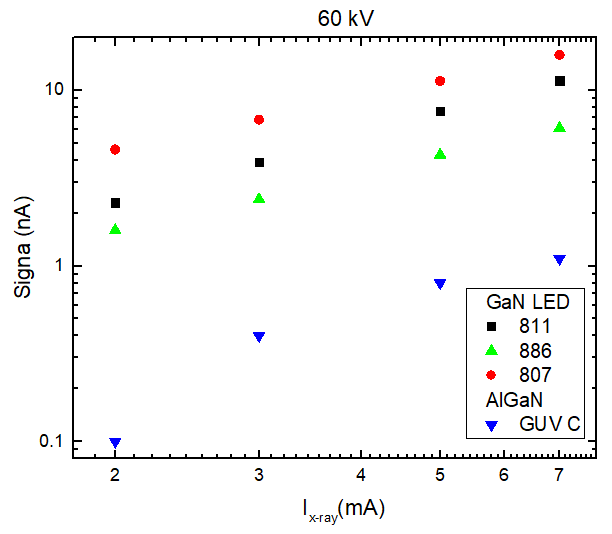
GaN LED 807 showed the highest X-ray sensitivity, with a linear response on a double logarithmic scale, suggesting reduced carrier recombination due to its thinner p-GaN layer. GUV C’s broader signal dispersion indicates higher noise and lower sensitivity, while the absence of response from GUV B is attributed to electrical contact failure.