
Carrier heating process in semiconductors is a result of intraband absorption, so-called below band gap absorption and interband absorption of photons with energy much larger than the band gap of a semiconductor. This nature of hot carrier effect gives reasons to discuss the controversial place of it in photovoltaics. On the one side, hot carrier photocurrent across a p-n junction suppresses classical photocurrent caused by electron-hole pair generation and thereby decreases the efficiency of solar cells because these currents have opposite polarities [1]. On the other side, since the hot carrier photocurrent current goes from the intraband absorption of photons, this phenomenon can be used to develop detectors of electromagnetic radiation of photons having energy below the band gap of the absorber. This study presents GaAs/AlGaAs ratchet sensor based on the hot carrier effect (Fig. 1) [2]. The detector was fabricated on an n-type GaAs wafer with two layers of graded gap GaAs-\(\mathrm{Al}_{0.2}\)\(\mathrm{Ga}_{0.8}\)As grown by liquid phase epitaxy. The sensor was illuminated with pulsed (17 ns) laser radiation of up to 10 MW/\(\mathrm{cm}^{2}\) light intensity of 1.064 m wavelength with corresponding photon energy 1.17 eV which is lower than the width of the GaAs band gap (1.42 eV). The photoresponse was recorded at 300 and 80 K temperatures and depicted in Fig 1. 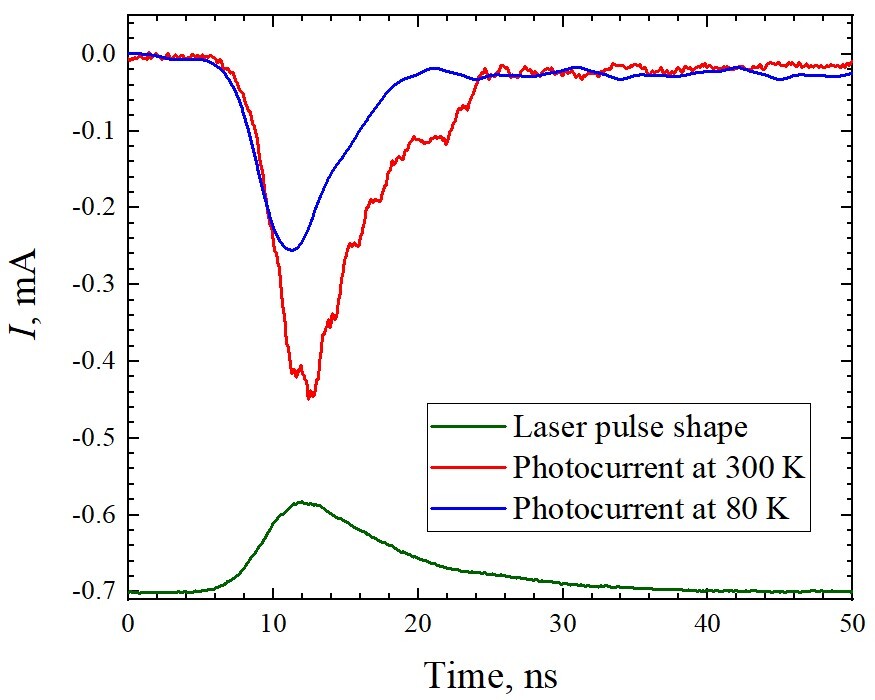
In conclusion, the ratchet-based GaAs/AlGaAs structure showed itself as a possible novel type of electromagnetic sensor operating based on the hot carrier effect. The band structure of the device is weakly dependent on the temperature, which makes it possible to use the sensor in a wide range of temperatures. To increase the voltage sensitivity, the number of active graded gap layers should be increased. Expected, that the sensor’s response time can reach the picoseconds scale, since the energy relaxation time of hot carriers is about 1 ps in semiconductors. Linear dependence of the output photocurrent on light intensity provides and simplifies an approach for setting the fitting function of the sensors. All these features make this device highly advantageous for a wide range of industrial applications.