Terahertz (THz) radiation is an electromagnetic field oscillations with frequencies in the range from 300 GHz to 10 THz (\(\lambda\) = 1 mm - \(\lambda\) = 30 µm). Such electromagnetic radiation can effectively penetrate materials that are opaque to visible light, but unlike X-rays, THz radiation is non-ionizing, making it safe for human health. In comparison to microwave radiation, THz waves offer superior spatial resolution, making them highly useful in imaging applications. These properties make THz radiation useful in various fields, including security, spectroscopy, medicine, and telecommunications. However, the development of cost-effective and high-speed detection methods for terahertz radiation remains a significant scientific challenge.
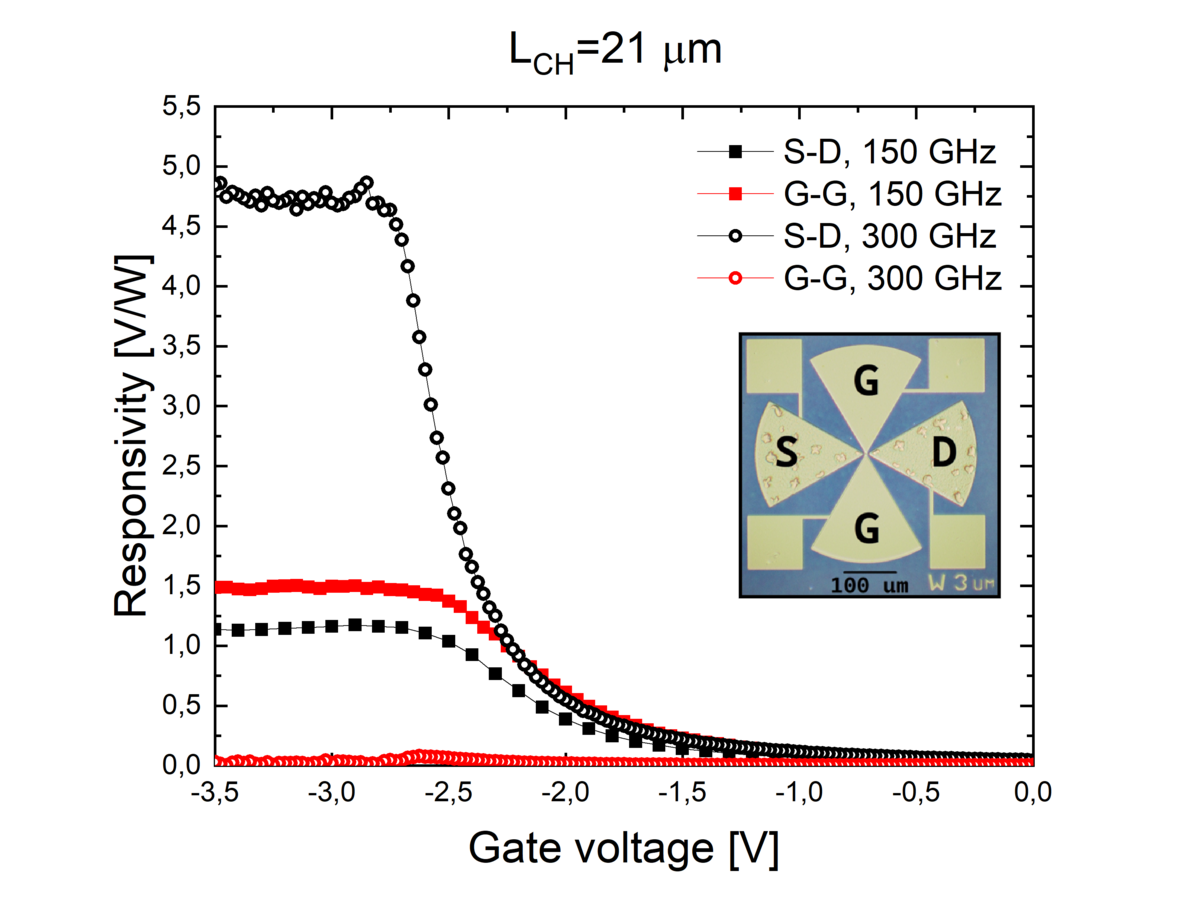
To address this problem, new semiconductor sensors for THz radiation are being developed, operating on the principle of plasma wave excitation in the channel of a high-electron-mobility transistor (HEMT) with a two-dimensional electron gas (2DEG) [1]. These sensors can function in either a resonant regime, where a narrow responsivity peak with high values is achieved, or a non-resonant regime, which provides the lower responsivity values but with the wider responsivity peak. To create a sensor capable of operating in both detection regimes, EdgeFET-type HEMTs have been proposed [2]. In this transistor geometry, the channel length is significantly larger than its width (\(L_{CH} >> W_{CH}\)), and two bow-tie antennas are connected to the transistor electrodes. The first set of bow-tie antenna elements is connected to the channel electrodes, forming an ohmic coupling (S-D). The second set of antenna elements consists of two gate electrodes, symmetrically positioned relative to the channel and connected through the AlGaN barrier, forming a capacitive coupling (G-G). This transistor geometry enables control of the channel width by applying a gate voltage, allowing switching between resonant and non-resonant operation modes.
In this work, the responsivity of modified AlGaN/GaN EdgeFETs with different channel lengths (21 µm, 13.5 µm, and 9 µm) to 150 GHz and 300 GHz radiation was investigated in a non-resonant regime. The results showed that the transistors responsivity at 150 GHz increases as the channel length decreases. Additionally, capacitive coupling (G-G) was found to provide higher responsivity values than ohmic coupling (S-D). When comparing sensor performance at different frequencies, the responsivity in ohmic mode (S-D) at 300 GHz was up to 5 times higher than at 150 GHz, whereas capacitive coupling (G-G) resulted in the lowest responsivity values.