
Organic light-emitting diode (OLED) technology has been established in the display sector due to its ease of fabrication and high energy efficiency. Current OLED displays employ low-efficiency fluorescent or expensive heavy metal-containing phosphorescent emitters. In recent years, thermally activated delayed fluorescence (TADF) materials have emerged as a promising alternative to currently utilized purely organic emitters, achieving 100% internal quantum efficiency [1]. However, developing stable and efficient blue OLEDs presents challenges due to high-energy exciton transitions, leading to increased degradation pathways. Host materials are vital in optimizing device performance by facilitating efficient energy transfer and suppressing undesirable intermolecular interactions. Therefore, engineering a proper host material for the emissive layer of blue TADF OLEDs is an essential step for the advancement of this technology. 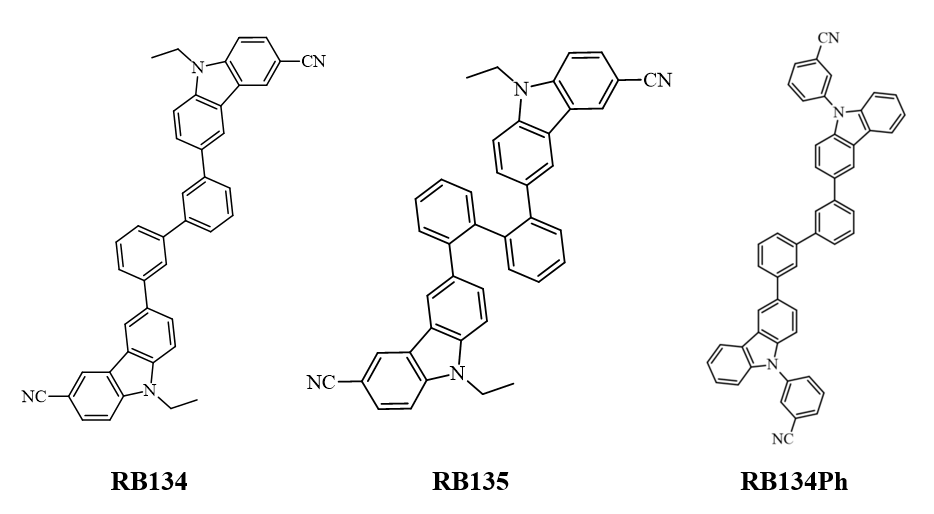
NOVEL HOST MATERIALS FOR STABLE BLUE THERMALLY ACTIVATED DELAYED FLUORESCENCE OLEDS
Domantas Berenis1, Rita Butkutė2, Gediminas Kreiza1, Giedrius Puidokas1, Vaida Jašinskaitė-Koženiauskienė2, Karolis Kazlauskas1
1 Institute of Photonics and Nanotechnology, Vilnius University, Saulėtekio av. 3 LT-10257, Vilnius, Lithuania
2 Department of Polymer Chemistry and Technology, Kaunas University of Technology, Radvilėnų rd. 19, LT-50254 Kaunas, Lithuania
[1] H. Uoyama, et al., Nature, vol. 492, no. 7428, pp. 234–238 (2012)
[2] A. S. D. Sandanayaka, et. al., J. Phys. Chem. C, 119 (42), 23845-23851 (2015).
[3] M. Hong, et. al., Chemistry of Materials 2016 28 (16), 5791-5798 (2016).