
Over the past few years, Low Gain Avalanche Detectors (LGADs) have demonstrated outstanding performance in detecting high-energy particles. They have been selected as the technology of choice for the timing detectors in the upcoming ATLAS and CMS upgrades of the High-Luminosity Large Hadron Collider (HL-LHC) [1]. Although LGADs exhibit good timing resolution and signal-to-noise (S/N) ratio when detecting high-energy charged particles due to the avalanche multiplication mechanism in the gain layer, they also suffer from radiation-induced performance degradation, which leads to the deterioration of silicon sensors’ functional characteristics caused by electrically active defects within the bandgap of the material and acceptor removal effect in the gain layer [2]. Therefore, characterizing particle sensors before and after irradiation is essential to predict variations in their parameters under ionizing radiation, assess radiation hardness, develop new structures, and explore alternative applications.
In highly irradiated sensors, defect densities can be comparable to or even higher than the dopant concentration. As a result, sensitive analytical techniques for determining deep-level parameters, such as Capacitance Deep Level Transient Spectroscopy (C-DLTS), become ineffective. C-DLTS measurements with LGAD sensors have shown unreliable spectra due to strong capacitance drop [3]. For this reason, optical excitation technique such as photoionization spectroscopy can be employed. The photoionization spectroscopy method was chosen for defects identification, which allows the determination of defect levels or their complexes in a material based on their activation (absorption) energies even with high defect densities.
In this study, two sets of LGADs produced by Hamamatsu Photonics (HPK) [4] and Centro Nacional de Microelectrónica (CNM) [5] with an active area of 1.3×1.3 mm\(^{2}\) were investigated in collaboration with CERN. The samples were irradiated with high energy protons (24 GeV) with fluences in the range of 10\(^{12}\) – 10\(^{16}\) p/cm\(^{2}\). Activation energies and types of irradiation induced electrically active defects will be presented and discussed.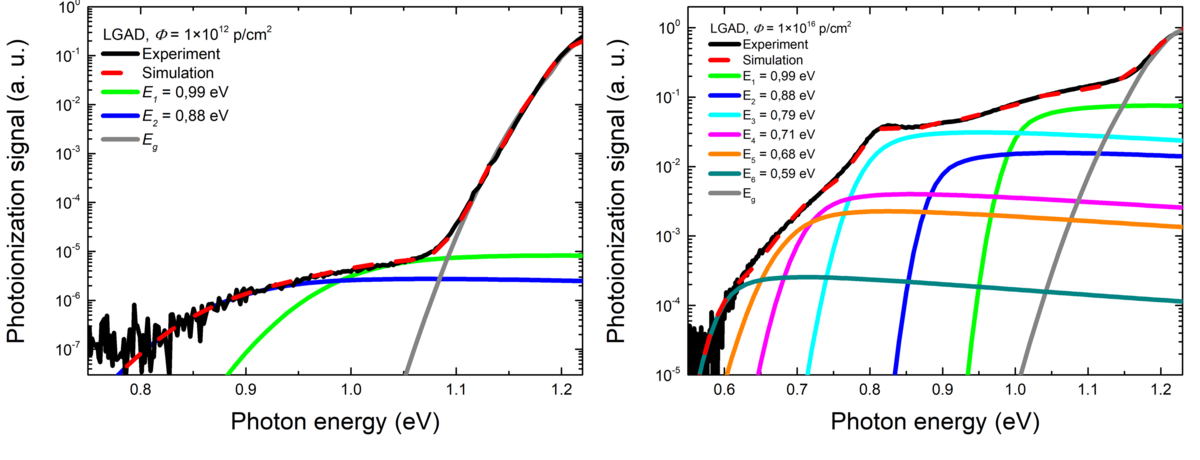
DEFECT SPECTROSCOPY IN PROTON IRRADIATED SILICON LOW GAIN AVALANCHE DETECTORS
Margarita Biveinytė1, Tomas Čeponis1, Laimonas Deveikis1
1 Vilnius University, Institute of Photonics and Nanotechnology
[1] E. Currás, M. Fernández, M. Moll, Gain suppression mechanism observed in Low Gain Avalanche Detectors (2021).
[2] M. Moll, Displacement damage in silicon detectors for high energy physics. IEEE Transactions on Nuclear Science 65, 1561-1582 (2018).
[3] A. Himmerlich, N. Castello-Mor et al., Defect characterization studies on irradiated boron-doped silicon pad diodes and Low Gain Avalanche Detectors. Nuclear Instruments and Methods in Physics Research Section A 1048 (2023).
[4] https://www.hamamatsu.com/jp/en.html (last checked 2025-01-29).
[5] https://www.cnm.es/ (last checked 2025-01-29).