Electromagnetic radiation (EM) emitted by various devices can affect other devices in their path, reducing their efficiency or even causing damage. EM shielding materials help prevent this. These materials, known as absorbers, act as barriers to the propagating radiation [1]. A material’s absorption increases with more electric and magnetic dipoles. Materials with high dielectric permittivity are the source of these dielectric dipoles [2]. Standard-filled materials require significant amounts of resources. Therefore, various structured materials are being developed. This approach aims to reduce resource consumption and lower production costs.
The objective of this study is to investigate the electromagnetic radiation absorption of composite materials with different concentrations of carbon nanotubes (1.3 wt % and 1.8 wt %) and barium titanate (BaTiO₃) (10 % and 20 %) across a broad frequency range. Additionally, it evaluates how the absorption coefficient depends on the 3D structure of the composite material.
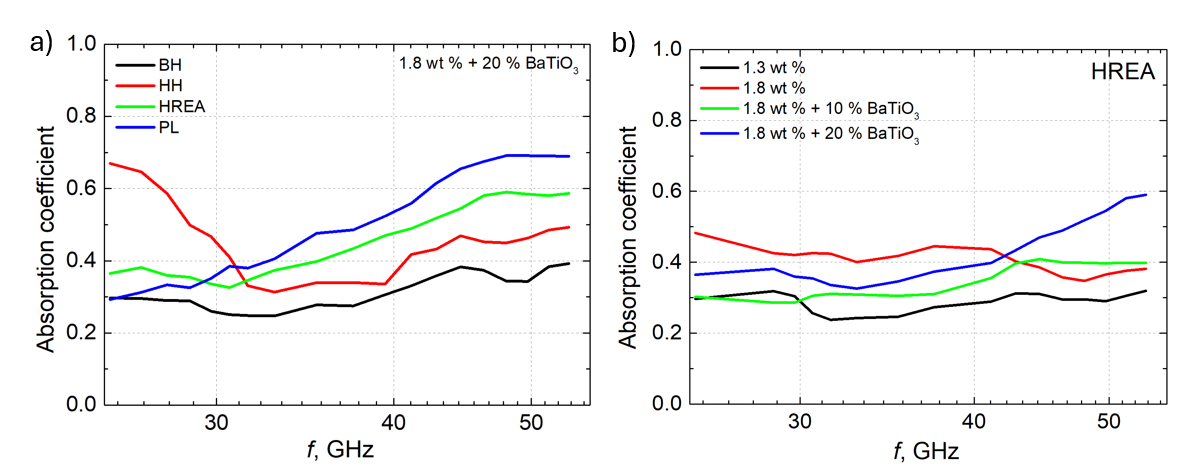
Figure 1 presents the measured dependence of the absorption coefficient on frequency for samples with different structures and compositions. The best absorption is observed in composites containing barium titanate additives. At the highest concentration (20 %), the highest absorption coefficient values (0.3 – 0.7) were recorded. In a filled plate, the absorption coefficient reaches up to 70 %. As the EM frequency increases, the HREA structure also exhibits rapidly rising values, with absorption increasing from 40 % to 60 %. The poorest absorption (30 % – 40 %) is observed in BH-structured samples containing barium titanate. It was determined that the most minor changes in absorption properties compared to the filled plate occur when using the HREA structure. Even at low concentrations (1.3 wt % and 1.8 wt %), carbon nanotubes used as polymer composite fillers enhance electromagnetic radiation absorption. Increasing the BaTiO₃ concentration further improves shielding properties. While the 3D structure significantly influences the material’s interaction with electromagnetic radiation, greater attention should be given to its composition to develop the most effective absorber for practical applications.