
Antimicrobial photodynamic inactivation (API) is a promising approach for combating drug- and pesticides-resistant pathogens, by generating reactive oxygen species (ROS) using photosensitizer (PS), light and molecular oxygen [1]. Chlorophyllin (Chl) is a water-soluble chlorophyll derivative, that exhibits photosensitizing properties, however, its anionic nature limits efficient penetration into bacterial cells, preventing intracellular ROS production. Non-toxic, natural, and cationic Chitosan (CHS) overcomes this limitation by enhancing cellular uptake due to its positive charge and intrinsic antimicrobial properties [2]. This study aims to investigate the molecular interaction dynamics and binding ratio between magnesium (Mg) Chl, copper (Cu) Chl, and chitosan (CHS) using Job plot analysis. Understanding the stoichiometry of these complexes (Fig.1) will provide insights into their self-assembly, stability, and potential aggregation, which are crucial factors directly affecting their antimicrobial photodynamic efficiency.
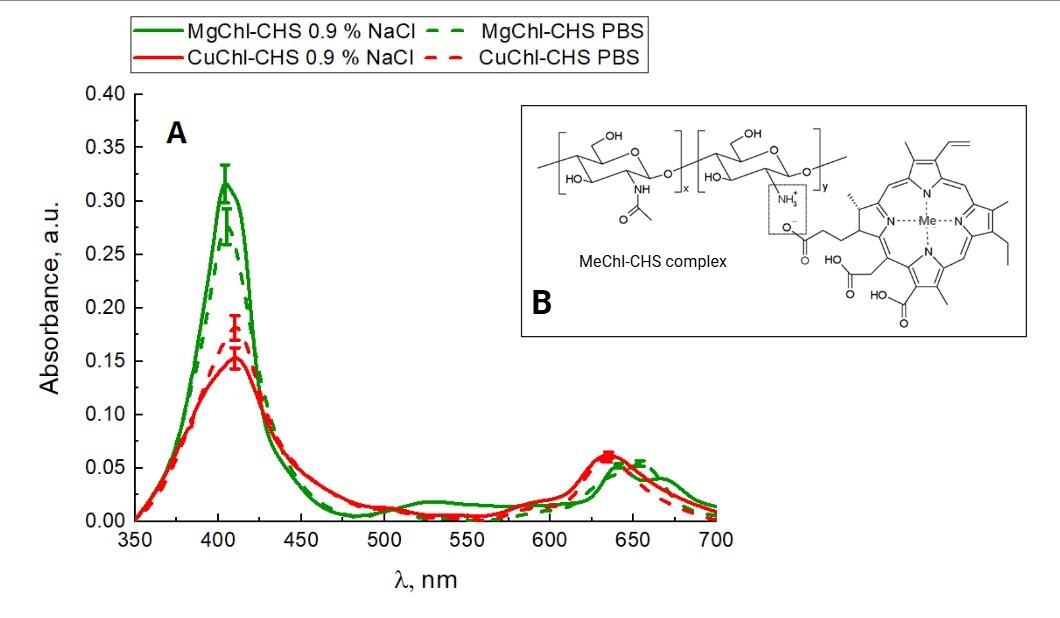
First, 0.05 % (w/v) Chl and 1.25 % (w/v) CHS stock solutions were prepared for Job plot analysis. These solutions were diluted using 0.9 % NaCl and phosphate buffered saline (PBS) solution to create 1 % (w/v) CHS and 0.01 % (w/v) Chl stock solutions. In the Job plot analysis, the total concentration of the complex was kept constant while varying the molar fraction of Chl (\(\chi_{Chl}\)). Job plot analysis was used to determine the Chl-CHS binding ratio by measuring absorbance changes at \(\sim\) 404 nm across varying \(\chi_{Chl}\). The molar fraction \(\chi_{Chl}\) was calculated using Equation (1):
\[\chi_{Chl} = \frac{n(Chl)}{n(Chl) + n(CHS)}\]
The Job plot analysis of CuChl-CHS and MgChl-CHS complexes revealed that both complexes have the highest absorbance shift at \(\chi_{Chl}\) 0.9 which indicate a 9:1 Chl:CHS binding ratio in both 0.9% NaCl and PBS solutions suggesting that complexes at this ratio have the most stable bond. However, the high binding ratio observed (9:1) may suggest the possibility of aggregation, cooperative binding, or the presence of multi-binding site systems that can influence API efficiency.
For further investigation, it is important to examine how the binding ratio influences ROS production, which in turn influences API efficiency.