
Foodborne pathogens pose a significant risk to public health, and the growing concern over antibiotic-resistant bacteria necessitates the development of alternative food safety strategies. Antimicrobial photodynamic inactivation (API) is a promising alternative to chemical disinfectants that is less likely to induce resistance. API relies on three components: a photosensitizer (PS), molecular oxygen, and light at a specific PS absorption wavelength [1]. Upon photoexcitation, the PS can undergo either a Type I or Type II reaction (Fig.1), generating reactive oxygen species (ROS) that induce microbial inactivation. API effectiveness depends on PS properties such as absorption, aggregation, and stability [2]. This study aims to analyze and compare the photophysical properties of natural PSs – magnesium chlorophyllin (MgChl), riboflavin (RF), and their mixture (RF/MgChl) in solution – to optimize API performance.
To evaluate the photophysical properties of RF/MgChl, separate stock solutions (0.15 mM) of RF and Mg-Chl were prepared in distilled water. RF was dissolved under continuous stirring at 50℃ for 3 hours to ensure complete solubilization and stability, whereas MgChl was stirred only 5 minutes at room temperature. For the RF/MgChl mixture, appropriate volumes of RF and MgChl stock solutions were combined and diluted in phosphate-buffered saline (PBS) to obtain final working concentrations of 0.0075 mM, 0.015 mM, 0.03 mM. 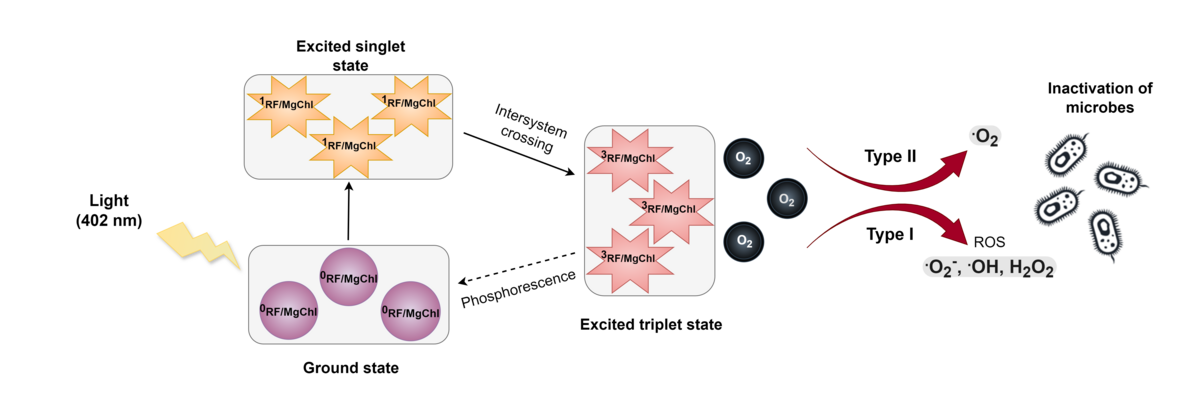
Spectrophotometric measurements were conducted to determine the absorption wavelengths of separate PS solutions and their mixture. Additionally, particle size distribution was analyzed to assess solution stability, as PS aggregation can impact API efficiency. Triton X-100, a known aggregate-disrupting agent, was used to the extent of PS aggregation and its effect on photophysical properties.
Spectrophotometric analysis showed that MgChl and RF exhibit distinct absorption maxima within the visible-light spectra: 402nm (MgChl) and 440nm (RF). Particle size distribution measurements revealed that MgChl solutions contain larger aggregates (300-5560 nm), whereas RF particles remain below 400 nm. The RF/MgChl mixture displayed intermediate properties, indicating potential aggregation interactions between the two PS. The larger MgChl aggregates suggest a potential reduction in photoactivity and ROS generation, which may influence API efficiency.
Further research will focus on fluorescence and photostability studies to determine the long-term effectiveness of RF, MgChl, and RF/Mg-Chl in API applications. Investigating light-induced degradation and ROS generation efficiency will provide deeper insights into optimizing PS mixtures for enhanced API performance.