
Terahertz (THz) radiation (0.1–10 THz) [1], has garnered significant attention for applications in atmospheric monitoring, industrial exhaust analysis, environmental sensing, and biomedical diagnostics, necessitating scalable, high-precision spectroscopic solutions.
This study focuses on THz methanol spectroscopy and the application of a theoretical model, which applies broadening to discrete spectral data taken from the Jet Propulsion Laboratory (JPL) molecular spectroscopy database [2]. The resulting spectrum, modelled under specific conditions, serves as a reference for comparing experimental data and assessing the performance of a 0.25 THz emitter-detector pair. These findings contribute to advancing THz technology and improving spectroscopic methodologies.
Modelling utilized JPL data, renowned for extensive THz-range spectral information, to predict methanol’s absorption line widths and its broadening mechanisms. As a key atmospheric trace constituent, methanol exhibits well-defined absorption features, making it an ideal reference for THz spectroscopy under higher stratosphere pressure conditions (<1 mbar). The spectral line broadening under investigation consists of Gaussian (Doppler, due to thermal motion) and Lorentzian (collisional/pressure) broadenings, both of which combine to form the Voigt profile [3]. Accurate modelling of these broadening effects is crucial for precise spectral analysis, reliable atmospheric sensing and understanding of dynamic energy exchange in the stratosphere for better climate change predictions. A Python-based computational approach was employed, overlaying the modelled Voigt profile onto reference spectra to refine Voigt profile parameters by optimizing spectral fits against reference methanol spectra at 134 mTorr and 298 K over 1.480 – 1.495 THz range [4].
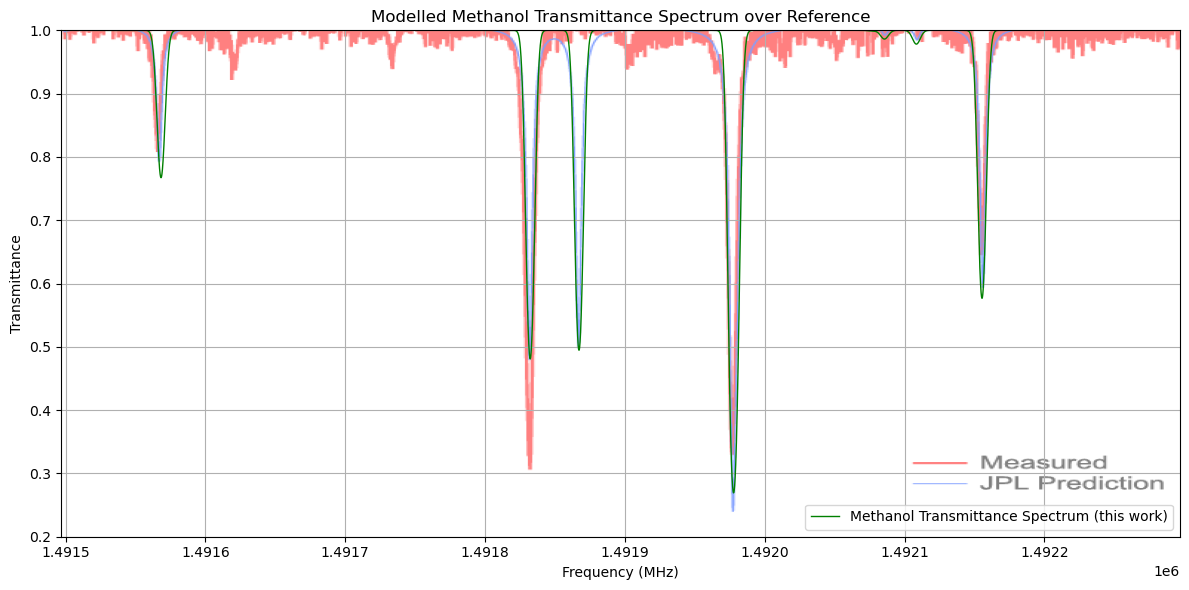
Future experimental validation will refine methanol spectroscopy using field-effect transistor-based THz spectroscopy under varying pressure conditions in a gas cell and applied gate voltages on a designed tunable 252 - 256 GHz source. This will allow a direct comparison between the experimental data and modelled spectra based on data extracted from the JPL database. The goal of the experiments will be to refine the measurement method to reach the highest possible spectral resolution.