Optical imaging systems are widely used in commercial and scientific fields, such as medicine, security, material analysis, and quality control [1]. These systems often rely on high-energy radiation, like X-rays, which have significant drawbacks, such as ionizing effects and high costs. Terahertz (THz) imaging offers a safer alternative, using non-destructive radiation that can still penetrate most dielectrics.
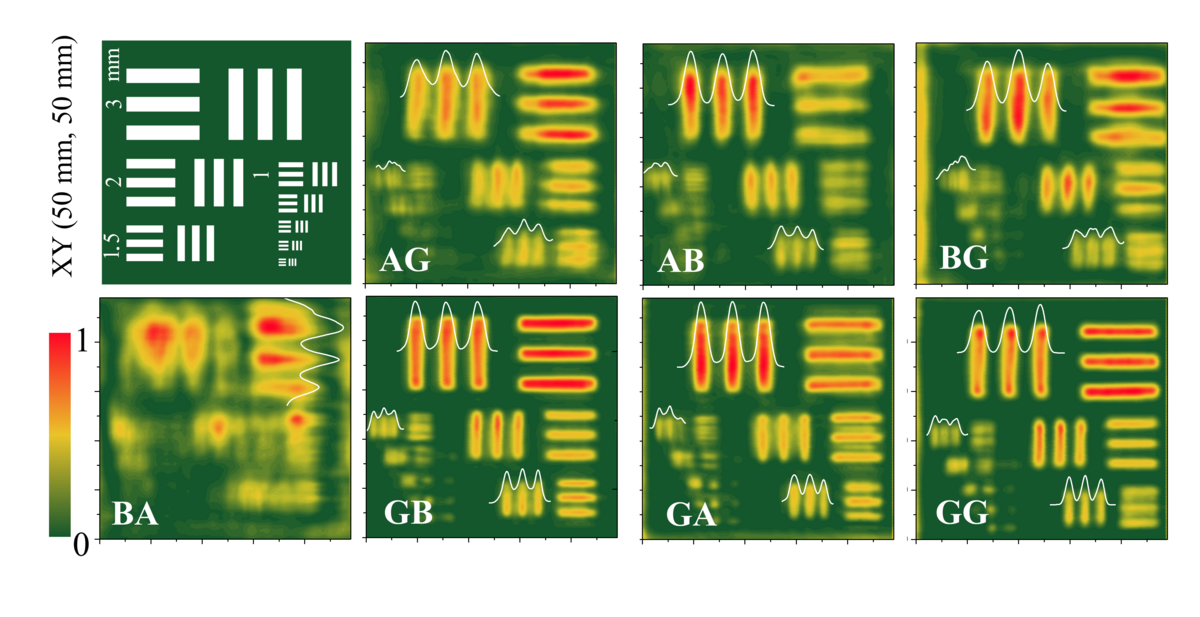
This study investigates the arrangement of optical components in THz imaging systems, focusing on Gaussian, Bessel, and Airy beam-forming lenses. These lenses were fabricated using extrusion 3D printing with High Impact Polystyrene filament, which offers suitable optical properties for the THz range [2]. The positions of the lenses were systematically adjusted to focus and collect light onto a resolution imaging sample (USAF1951) (Fig. 1.). Seven images with different lens combinations were recorded (Fig. 1). For each combination, the Modulation Transfer Function (MTF) was evaluated to assess the system’s contrast, and the Mean Square Error (MSE) was used to compare imaging quality [3]. The contrast data helped identify the optimal conditions for achieving the highest resolution.
The results show that the types and positions of lenses play a crucial role in THz imaging. The combination of classical Gauss-Gauss lenses provided the highest quality imaging but was highly sensitive to misalignment. In contrast, the Bessel lens for light collection proved to be optimal, as it significantly reduced the sensitivity to system alignment.