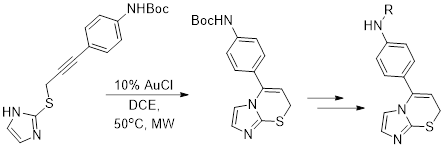
Interest in the study of protein aggregation and amyloid formation is growing, mainly due to their links to various neurodegenerative and systemic diseases such as Alzheimer’s disease, Parkinson’s disease, and type II diabetes [1]. Amyloid fibril formation is a defining feature of these conditions, making the quest for effective inhibitors of this process critically necessary, scientifically and medically [2]. Recent research has indicated that imidazo[2,1-b][1,3]thiazine derivatives may be promising modulators of amyloid aggregation [3]. In this study, we focus on the synthesis and characterization of 4-(7H-imidazo[2,1-b][1,3]thiazin-5-yl)aniline, along with its carbamate and amide derivatives. These modified compounds are intended to enhance bioavailability, stability, and interactions with amyloidogenic proteins.
Our synthetic approach involves the cyclization reaction of starting 2-alkynylthioimidazoles to yield corresponding 4-(7H-imidazo[2,1-b][1,3]thiazin-5-yl)aniline. The second step entails functionalizing the aniline group through carbamation and amidation reactions, utilizing appropriate electrophilic reagents. The results of this study will provide insights into the structure-activity relationships of imidazo[2,1-b][1,3]thiazine-based inhibitors and contribute to the development of new therapeutic strategies for amyloid-related diseases.