
Benzoxazole-based structures play a significant role in medicinal chemistry due to their broad spectrum of biological activities. These fused oxazole-benzene systems exhibit promising antifungal, antibacterial, anti-inflammatory, and anticancer properties.[1, 2, 3] This study focuses on the synthesis of novel benzoxazolinone derivatives with potential biological activity.
The precursor acid was synthesized via bromination of 3-(2-oxobenzo[d]oxazol-3(2H)-yl)propanoic acid in the presence of acetic acid (Fig. 1). The molecular structures of benzimidazole-containing compounds –6 were obtained through the Phillips reaction. Compound was synthesized from precursor using polyphosphoric acid (PPA). To achieve the target acid hydrazide , a standard synthetic pathway - acid to ester to hydrazide - was employed. Finally, hydrazide was condensed with various aromatic aldehydes to introduce the hydrazone moiety –18.
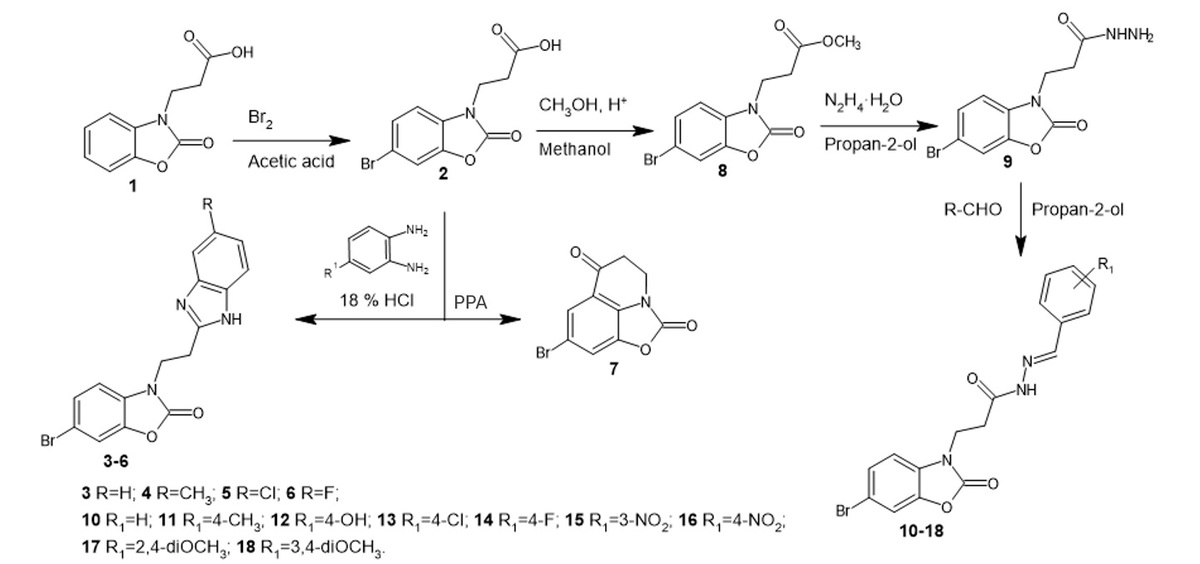
The structure of the synthesized compounds was characterized by spectral data (IR, NMR spectra, and elemental analysis). The spectra showed good agreement with the assigned molecular structures.