Amyloid fibril formation is a hallmark of numerous neurodegenerative and systemic diseases, including Alzheimer’s disease, Parkinson’s disease, and type II diabetes. The aggregation of misfolded proteins into amyloid plaques has been identified as a key pathological process contributing to cellular dysfunction and toxicity[1]. The urgency of identifying effective inhibitors of amyloid aggregation has led to extensive research into small-molecule modulators capable of disrupting fibril formation or stabilizing non-toxic conformations of amyloidogenic proteins[2]. Among these small molecules, imidazole-based compounds have emerged as promising candidates due to their unique electronic properties and ability to interact with protein aggregation pathways[3]. The imidazo[2,1-b][1,3]thiazine scaffold, in particular, has garnered interest for its bioactive potential, as derivatives of this core structure have demonstrated anti-amyloidogenic properties[4].
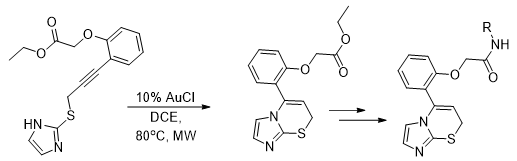
Following previous research, ethyl 2-(2-(7H-imidazo[2,1-b][1,3]thiazin-5-yl)phenoxy)acetate was chosen for functional group position evaluation in the core structure of 5-arylimidazo[2,1-b][1,3]thiazine. The desired compound was synthesized with a cyclization reaction of appropriate 2-alkynylthioimidazole. Further modification of the ester group led to a purposive group of compounds required for further structural-activity relationship investigation on inhibition of alpha-synuclein aggregation.