
ZnO based materials attracted recently much attention due to their unique optical properties, such as high exciton binding energy (e.g. in ZnO 60 meV [1]). High exciton binding energy leads to the existence of excitons even at room and higher temperatures. Such property of ZnO could be utilised for creation of UV laser involving excitons with very low operation threshold. High operation efficiency of such lasers can be reached by employing multiple quantum wells structures with MgZnO, as a barrier material.
Luminescence properties of ZnO and MgZnO MBE grown samples were explored in this work. Sample A is just a ZnO layer (thickness of 650 nm) grown on sapphire substrate, sample B is ZnO layer (thickness of 340 nm) grown on sapphire substrate with undoped GaN buffer layer and sample C is MgZnO layer (thickness of 320 nm) on the top of ZnO-u-GaN-sapphire system. Time-integrated and time- resolved luminescence spectra were studied at high and low excitation conditions. Low power light emitting diodes and semiconductor laser were used for low excitation regime. Luminescence signal was detected by CCD camera (Hamatsu H6780) and time correlated single photon counting system (Picoquant Picoharp 300). High excitation conditions were performed by utilising picosecond laser Ekspla PL – 2140. Time-resolved spectra were measured by applying optical Kerr gate technique.
UV luminescence band at 3.24 eV due to excitonic radiative recombination and defect states related green luminescence band are observed at 2.4 eV at low excitation regime. No luminescence signal was detected from MgZnO epilayer at low excitation regime (order of μW). Time-resolved luminescence demonstrated ~6 ns luminescence decay time from ZnO layer at near-band edge region which indicated high optical quality of MBE-grown sample.
Under high excitation, ZnO samples exhibit a single luminescence band of exitonic origin in spectral region of 3.25-3.27 eV (Fig. 1). Luminescence intensity linearly depends on excitation power density; the band maximum does not shift and broadens with increasing excitation. These feature can be attributed to inelastic exciton-exciton scattering (P∞ band). After a particular excitation density (>0.3 mJ/cm2, similar in both A and B samples), a new luminescence band at about 3.14 eV emerges. Emission intensity dependence on excitation density shows super-linear behaviour, which is typical for stimulated emission, in particular involving inelastic exciton-exciton scattering process. With increase of excitation power density, stimulated emission band starts to redshift and broaden. This implies that a new recombination mechanism, namely, recombination of electron-hole plasma (EHP) rises up. Redshift of EHP band is accounted to the band gap renormalization effect [2]. The insulator-conductor transition in a dense exiton system is called the Mott transition and is typical for highly excited semiconductor materials [2]. The estimated critical Mott density in ZnO is of 1019 cm-3. As both ZnO A and B samples exhibit similar luminescence properties, it can be suggested that buffer layer in ZnO B sample does not improve crystal quality of MBE grown ZnO epilayers.
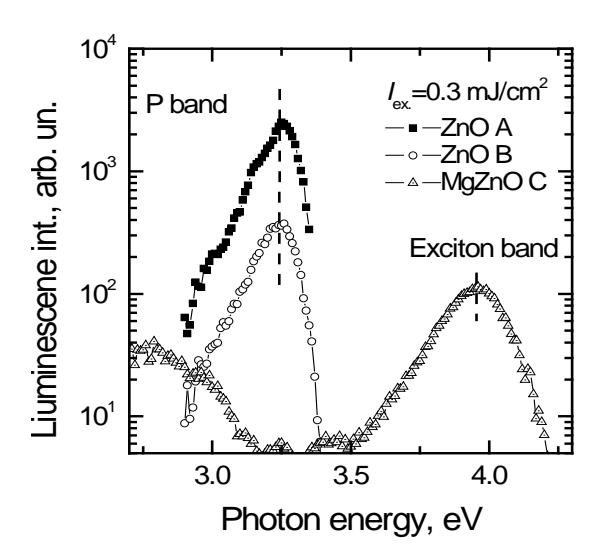
Two dominating luminescence bands are observed in the luminescence spectra of MgZnO (sample C) (triangles in Fig. 1). The origin of the first luminescence band located at about 2.7 eV is related to intrinsic point defect states. In accordance with the increased bandgap of this ternary compound, it is blueshifted in respect of well known green luminescence of ZnO. The second luminescence band is peaked at about 3.95 eV and is caused by radiative transition at near band-edge of MgZnO. Linear luminescence intensity dependence on excitation power density reveals excitonic nature of MgZnO band. It should be noted, that intensity of MgZnO luminescence band is about 20 times lower than that of ZnO samples (sample A).
Taking into account the peak position of the band edge emission one can roughly estimate the value of Mg concentration being 30%. This Mg concentration is close to the critical value when MgZnO lattice changes from wurtzite to cubic [1]. Therefore phase transition of in MgZnO system can cause poor optical quality of the epilayer and thus can rise further problems for creation of ZnO/MgZnO multiple-quantum-well based light emitting devices.