
The spontaneous parametric down-conversion (parametric fluorescence) in crystals with $\chi^2$ nonlinearity was observed experimentally in 1967 [1]. In this process, three optical fields with different frequencies, satisfying conservation of energy and momentum, are coupled through the second-order nonlinearity of the medium. Photon generation via parametric down-conversion, pumped by a laser source of high spatial and temporal coherence, is accessed in many different operating regimes, ranging from a single photon [2] to broadband [3] emission and in a variety of the nonlinear media using different interaction geometries [4]. In this contribution we report how the parametric fluorescence with appreciable power is generated in bulk LiIO3, KDP and BBO crystals, using an incoherent high-brightness blue LED as a pump source [5].
Fig. 1 shows examples of the angular distributions of the parametric fluorescence excited in type I phase matching LiIO3, and KDP crystals, recorded with pump power of 0.53 mW, and in type II phase matching BBO crystal, recorded with pump power of 77 μW. The crystal offset $\Delta\theta$ is defined with respect to the scalar phase matching angle for degeneracy $\theta^s$ for central pump wavelength (457 nm). We also show how the coherence properties of the parametric fluorescence 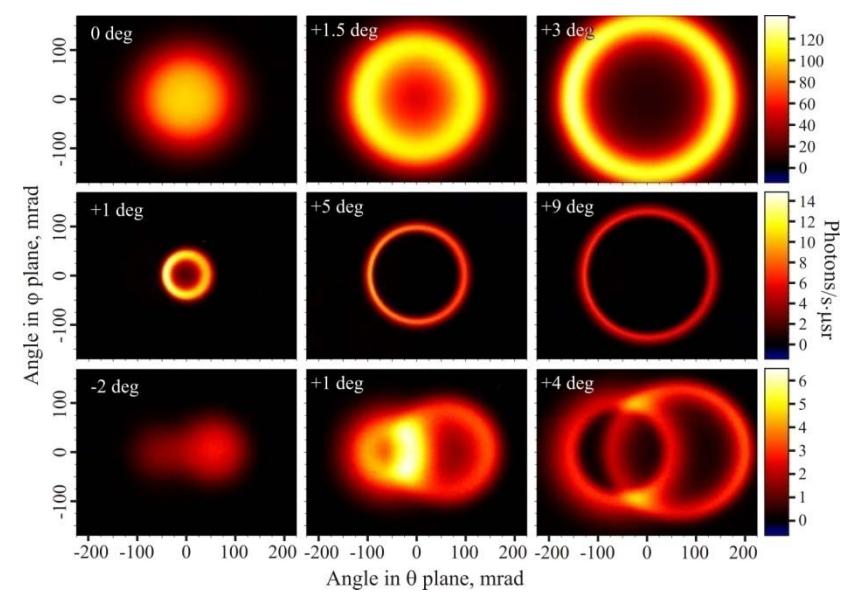
Present results suggest that high-brightness LEDs could be used as an attractive alternative to laser sources for excitation of well-detectable parametric fluorescence in bulk nonlinear crystals, so making LED a versatile source for many experiments in quantum optics, for instance, for studies of quantum-classical transitions and for testing of quantum communication networks, to mention a few.