
Progress in nanometer technology has triggered a broad activity in low dimensional quantum systems [1]. During the last five years the interest has shifted to graphene [2, 3], the single layer of graphite that is an ideal two-dimensional system. Charge carriers in graphene behave like "relativistic" massless particles, and due to so-called Klein effect [4] the control of their behavior by means of the electromagnetic fields is one of the most challenging tasks. This situation occurs because the quantum dots in graphene have no bound states, and the electrons escape from them sooner or later. Thus, the description of quasibound states becomes of importance. For this purpose various approximate methods are used, mostly considering some approximate stationary problem. One of them is so called the complex energy technique [5], which relates the imaginary part of energy eigenvalue with the inverse lifetime of quasibound state. The other way to determine the above lifetime is to extract it from the width of resonances in so called local density of states of artificially confined system [6, 7]. The quasi-classical approach [8] for the description of the quasibound states is also used.
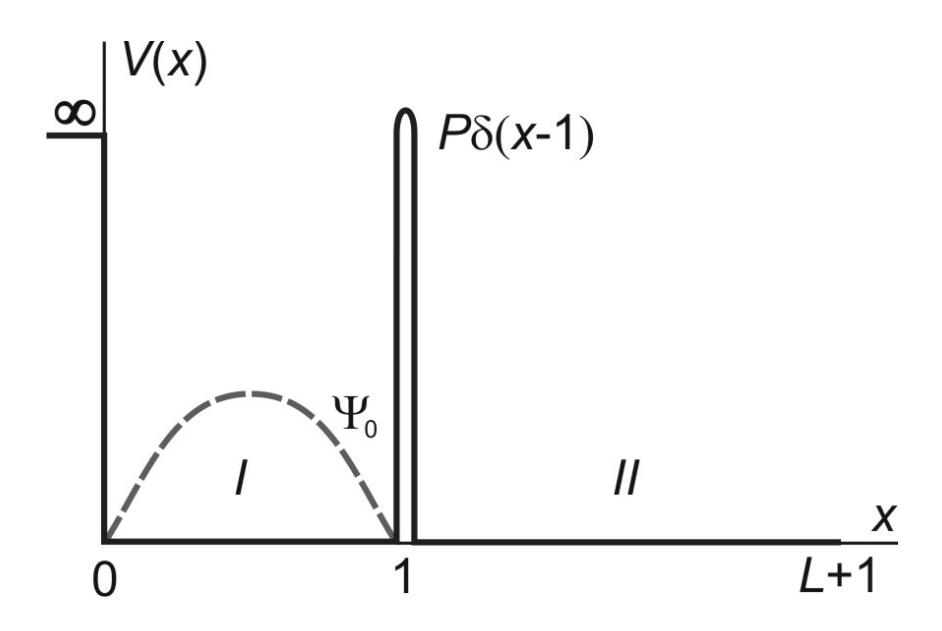
The aim of this work is to evaluate the advantages and shortcomings of various approximate quasibound state description methods comparing the results with the exact solution for analytically solvable model of decaying quantum state, which is an example of most simple non-stationary problem. For this purpose we use the model of one-dimensional (1D) quantum system, described by Schrödinger equation
$$i\hbar \frac{\partial}{\partial t} \Psi(x,t) = \left\{ -\frac{\hbar^2}{2m} \frac{\partial^2}{\partial x^2} + V(x) \right\} \Psi(x,t), \tag{1}$$
where the electron moves in the potential V(x) shown in Fig. 1, with repulsive $\delta$-function that separates the quantum dot (region I) from the infinite half x-axis (region II) [9]. At initial time moment (t=0) electron is described by wavefunction $\Psi_0$, which corresponds to ground state of isolated quantum dot, i.e. $P = \infty$. This model has been examined by a number of people, in particular, by Petzold [10] and Winter [11], and more recently by Dijk [12] mostly in relation with the problem of radioactive decay of nucleus.