FABRICATION OF 3D PHOTONIC CRYSTALS BY MULTI-PHOTON FABRICATION
M. Rutkauskas1, L. Maigytė2, M. Malinauskas1, M. Peckus1, K. Staliūnas2
1 Vilnius University, Physics Faculty, Department of Quantum Electronics, Laser Research Center, Saulėtekio ave. 10, LT-10223 Vilnius, Lithuania
2 ICREA, Departament de Fisica i Enginyeria Nuclear, Universitat Politecnica de Catalunya, Colom 11, E-08222 Terrassa, Barcelona, Spain
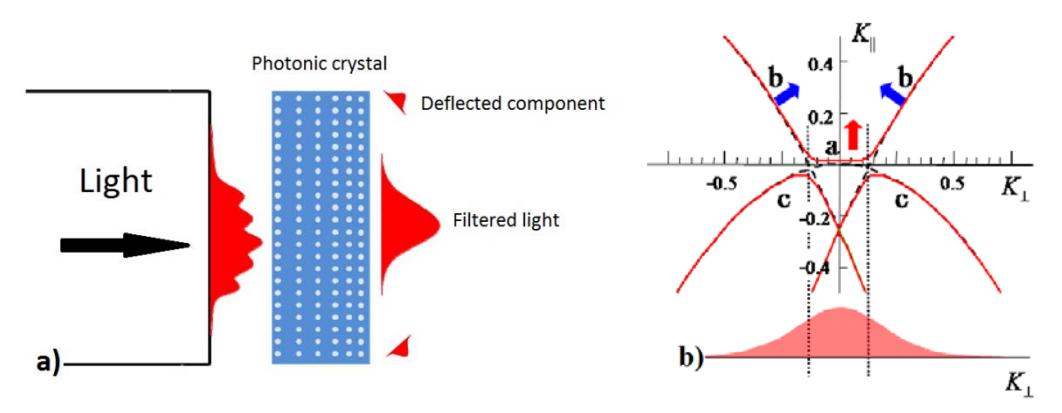
Recently Photonic Crystals (PhC) have drawn high attention due to possibility to form photonic bandgaps, ranges of frequencies in which light cannot propagate through. These elements are attractive for controlling and manipulating the flow of light. PhC are the structures with periodical refractive index modulation, where periodicity is proportional to the wavelength of light. Under these conditions light propagation depends on it's the spatial distribution resulting to spatial filtering, Fig. 1 [1,2]. It is challenging to create 3D PhC, which could be used for visible light due to required high structuring resolution [3]. One of the possibilities to fabricate such photonic elements of woodpile geometry is Laser Two-Photon Polymerization (LTPP) [4].
Fig. 1. a) Spatial filtering of light propogating through PhC. b) The part of the beam with wavevectors on the flat segment of the curve propagates diffractionless through PhC; the other part of the beam with wavevectors positioned at the slopes of the curve is strongly deflected, and thus filtered out [1,2].
LTPP is a direct laser writing technique based on ultra-localized polymerization reaction initiated by nonlinear absorption of short pulsed light in the tiny volume of the photosensitive material. By moving the sample relatively to the fixed focus spot it is possible to point by point modify the material along the scanning trace with subdiffractional resolution [5].
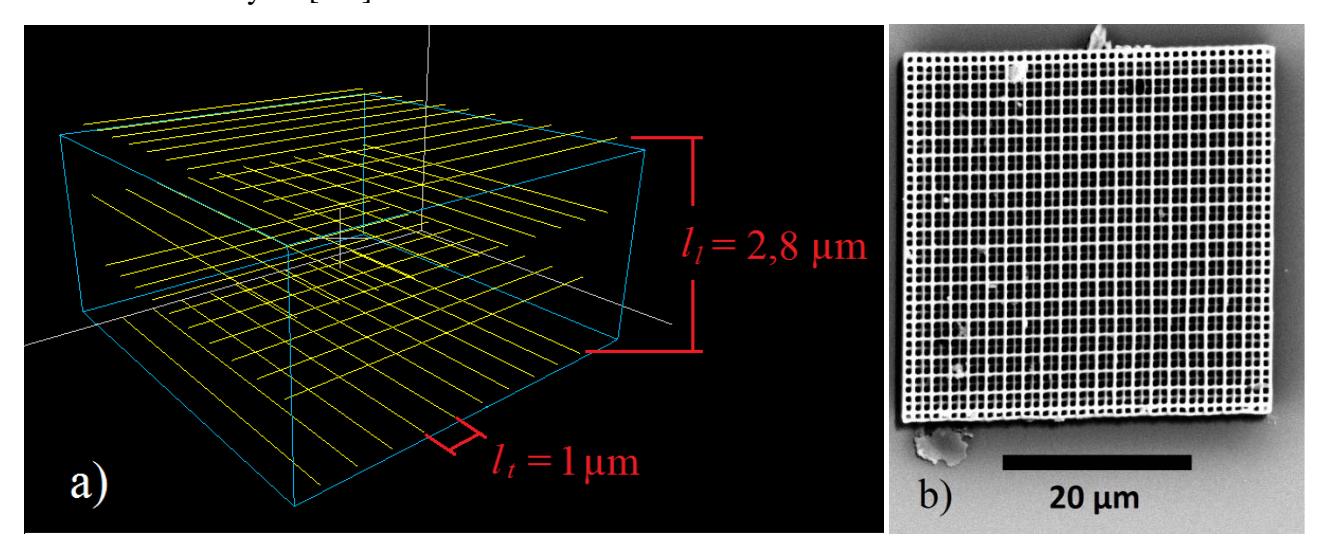
PhC and chirped PhC were theoretically designed and fabricated for red and green light. There are three essential parameters of the PhC to specify: the variance of refraction index, the longitudinal $l_l$ and transverse $l_t$ periods of the modulation index.
Rough specification is that the refractive index modulation wavenumbers in transverse direction $q_t$ and the longitudinal $q_l$ direction must fulfill the following condition:
$$q_t^2 + (k - q_l)^2 = \sigma^2 k^2 \tag{1}$$
In Eq. (1) $k$ is the wavenumber of the radiation in the material and $\sigma$ is the parameter depending on the angular width of the filtering $\Delta k$. The spatial filtering efficiency depends on number of PhC layers [1-2].
Fig. 2. a) Image of computer generated PhC. b) SEM image of PhC fabricated via LTTP technique.
The theoretically designed photonic crystals were manufactured out of Zr containing hybrid organic-inorganic SZ2080 (FORTH) photopolymer ($n = 1,504$) via LTPP technique. The quality of elements was investigated with Scanning Electron Microscope (SEM). Later, in order to tune the refractive index modulation, the 3D matrix was infiltrated with required refractive index monomer.
[1] K. Staliunas, V.J. Sánchez-Morcillo, I.Pérez-Arjona, F. Redondo and V. Espinosa, Method and device for efficient filtering of spatial structure of light beams, Spanish patent (2007).
[2] K. Staliunas and V. J. Sánchez-Morcillo, Phys. Rev. A **79**, 053807 (2009)
[3] S. Juodkazis, V. Mizeikis and H. Misawa, Adv. Polym. Sci. **213**, 157-206 (2008).
[4] J. Serbin, A. Ovsianikov and B. Chichkov, Opt. Express **12**, 5221-5228 (2004).
[5] M. Malinauskas, H. Gilbergs, V. Purlys, A. Žukauskas, M. Rutkauskas and R. Gadonas, Proc. SPIE **7366**, 736622 (2009).